

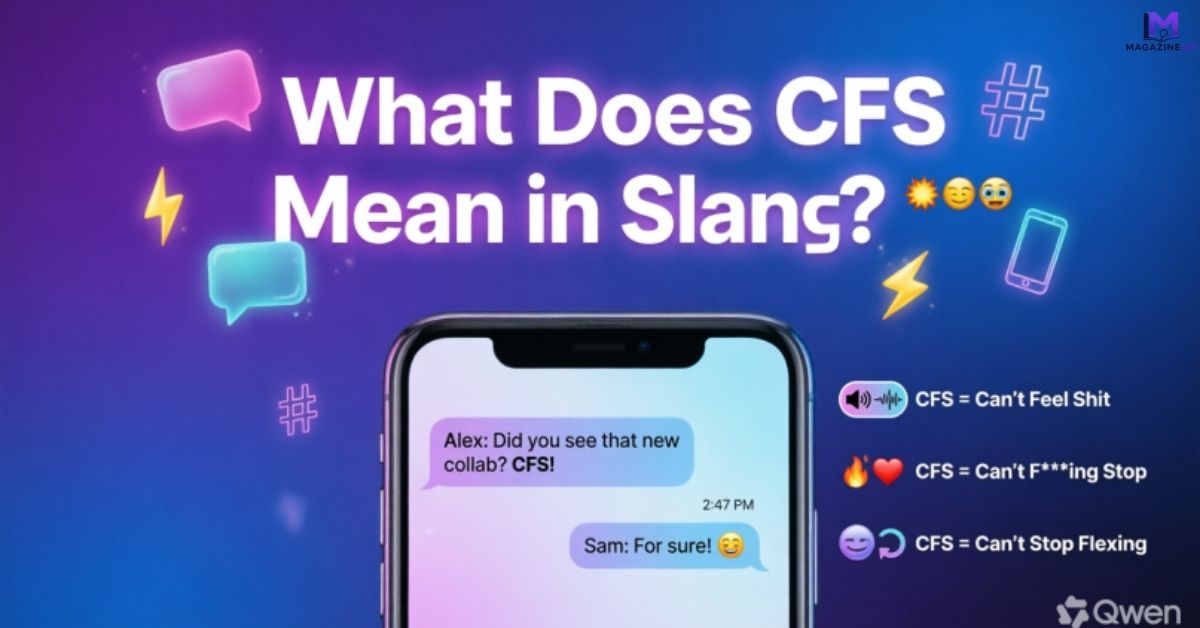
If you have seen someone write “CFS” in a message, caption, comment, or story, the intended definition usually depends on context. In social media conversations, the most common CFS meaning is Close Friends Story, especially when someone is talking about Instagram.
The term belongs to modern slang and online language. People use CFS when discussing a limited audience, personal content, candid moments, or an inner circle. In other situations, CFS can refer to a medical condition, a shipping term, or workplace terminology.
Understanding the surrounding conversation is therefore important. A message about Instagram followers has a very different meaning from a conversation about symptoms, logistics, or business operations.
What Does CFS Mean?
The most common CFS meaning in social media slang is Close Friends Story. On Instagram, a Close Friends Story lets someone share content with selected followers rather than everyone who can normally view their stories.
A CFS can therefore function as a private social media circle. Someone may use a CFS post for jokes, personal posts, candid moments, relationship updates, or content intended only for trusted friends. The audience is deliberately limited.
The term CFS slang is strongly connected with Instagram Close Friends and the Close Friends feature. A person may also simply write CF, meaning Close Friends. The two expressions can overlap in casual conversation.
For example, someone might say:
- “Add me to your CFS.”
- “Check my CFS.”
- “I posted it on my CFS.”
- “See my CFS later.”
- “The CFS was popping off.”
- “I need to clean out my CFS list.”
These examples show how the acronym can describe both the audience and the content shared with that audience.
Someone might also say they are CFS-ing something, meaning they are putting it into their restricted story audience. In everyday social media terminology, CFS has become shorthand for selective sharing.
The important distinction is that a CFS is not necessarily the same as a public post. A public post is intended for a broad audience, while CFS content is designed for selected followers.
Origin and History of “CFS”
The Close Friends feature was introduced by Instagram in November 2018. Before that Instagram users who wanted greater privacy often relied on a private Instagram account, a second profile, or a secret account.
One popular form of secondary profile became known as a Finsta. A Finsta, or fake Instagram account, could be used to share personal material with a smaller group. The arrival of Instagram Close Friends provided a simpler form of audience control without requiring another profile.
The November 2018 Close Friends launch became an important moment in Instagram history because users could separate private content from public content while keeping the same Instagram account.
As Instagram users adopted the feature, the CFS abbreviation became convenient in texting, captions, and comments. Gen Z users helped popularize the acronym across everyday slang, social media slang, and casual language.
The CFS meaning stayed closely connected to selective sharing because the feature itself remained centered on a restricted audience. Instead of making an entire account private, users could control story visibility on a post-by-post basis.
This development reflects the broader social media evolution toward audience segmentation. People increasingly wanted privacy controls without giving up their public profile, Instagram followers, or social media presence.
It also changed how people thought about online boundaries. Someone could have hundreds of Instagram followers while sharing personal content with only a few trusted friends.
How “CFS” Is Used on Different Platforms
Instagram remains the main platform associated with CFS. The CFS meaning on Instagram is generally tied to the Close Friends feature, Instagram Stories, and restricted story visibility.
On Instagram, a CFS story can appear with a green circle or green icon rather than the normal story indicator. The green circle tells eligible viewers that the story was shared with a Close Friends audience.
Instagram privacy settings also give users control over who belongs to their selected audience. The person creating the story manages the CFS list rather than allowing every follower to view the content.
On TikTok, CFS may appear in TikTok videos or TikTok posts when people discuss their private Instagram activity. Someone may say that a funny moment originally appeared on their CFS and then discuss it in a TikTok video.
TikTok does not make CFS its native equivalent of Instagram’s Close Friends feature in the same way. Therefore, CFS on TikTok usually refers to the concept or to an Instagram audience.
On X, formerly Twitter, people can use CFS when discussing Instagram culture, social circles, or selective audiences. Twitter conversations may turn CFS into a joke about who belongs in someone’s private social media circle.
Snapchat has a similar concept through Snapchat Private Stories. The terminology is different, but both systems involve selected viewers and restricted content.
| Platform | Typical CFS context | Audience idea |
| Close Friends Story | Selected followers | |
| TikTok | Discussion of private Instagram content | Indirect reference |
| X | Social commentary or jokes | Restricted audience concept |
| Older platform terminology | Selective sharing | |
| Snapchat | Similar concept through Snapchat Private Stories | Chosen viewers |
Across social media platforms, CFS therefore works mainly as an internet acronym associated with private sharing rather than as a universal technical feature.
CFS in Texting vs. Real Life
In texting, CFS is usually used as a quick abbreviation. A friend might send a group chat message saying, “Check my CFS,” expecting the recipients to understand that they should look at a private story.
This is a good example of texting slang becoming part of everyday communication. People often shorten longer expressions because acronyms make messages faster to write.
CFS can also appear in text messages, group chats, comments, and captions. Someone might mention a CFS post while explaining where they shared a photo or story.
In spoken slang, people may pronounce C-F-S as individual letters. The spoken slang form can occur in casual conversation, particularly among people who regularly use social media.
However, CFS is less appropriate in formal communication. A teacher, manager, customer, or unfamiliar audience may not know the abbreviation. In professional situations, writing “Close Friends Story” is usually clearer.
The written acronym is especially useful when everyone in the conversation already understands the social media terminology.
Examples of “CFS” in Sentences
“CFS” is commonly used in casual messages, captions, and conversations to mean Close Friends Story.
GROUP 1 — Friendly/Casual
- “Add me to your CFS; I want to see the funny posts.”
- “Did you check my CFS?”
- “I posted it on my CFS because only my friends needed to see it.”
- “See my CFS when you get a chance.”
- “My CFS list needs cleaning.”
These examples show ordinary friendship and social circle usage. A CFS list can include best friends, trusted friends, classmates, relatives, or other selected followers.
GROUP 2 — Romantic/Flirty
- “He added me to his CFS, so maybe there is something going on.”
- “She posted a relationship soft launch on her CFS.”
- “Getting a CFS invite can sometimes feel meaningful.”
- “I saw the flirting post on her CFS.”
- “He put the romantic story on his CFS.”
A CFS invite does not automatically indicate romantic interest. It can simply mean that someone trusts you or wants you to see their personal content.
GROUP 3 — Sarcastic/Humorous
- “My CFS is basically my support group.”
- “The CFS was popping off after the group chat argument.”
- “My CFS story is just me complaining about school.”
- “CFS drama starts before breakfast.”
- “Everyone on my CFS knows the tea already.”
CFS slang often appears with humor because a restricted audience can create an informal atmosphere.
GROUP 4 — Online/Caption Use
- “Reply if you want to be added to my CFS.”
- “Check my CFS for the full story.”
- “Posted it on CFS because the public post was not necessary.”
- “See my CFS for the storytime.”
- “CFS viewers know what happened.”
The phrase “post on CFS” can refer broadly to uploading content for a selected audience. The content might be a photo, video, text-based story, joke, personal update, or candid moment.
Variations and Related Slang
The shortest related form is CF, which means Close Friends. Someone may write “CF” instead of CFS when referring to the audience itself rather than the story.
The expression Green Circle is another informal description connected with Instagram’s green circle and green icon. The visual indicator helps story viewers recognize that a story has restricted visibility.
Finsta is another related term. A Finsta is commonly understood as a secondary or fake Instagram account created for a more limited audience. It differs from a CFS because a CFS exists inside the user’s primary Instagram account.
Private Story is particularly associated with Snapchat. Snapchat Private Stories serve a similar purpose, but the terminology belongs to a different platform.
| Term | Meaning | Main distinction |
| CFS | Close Friends Story | Instagram restricted story |
| CF | Close Friends | Shorter audience label |
| Finsta | Fake Instagram account | Separate account |
| Private Story | Restricted Snapchat story | Snapchat terminology |
| Green Circle | Informal CFS reference | Visual Instagram indicator |
| NGL | Not gonna lie | Different slang expression |
| ICL | I can’t lie | Different slang expression |
| YK | You know | Different abbreviation |
| OPP | Context-dependent slang | Not a CFS equivalent |
| Lumon | Context-dependent reference | Not an Instagram privacy term |
Related slang such as soft launch, thirst trap, tea, drama, storytime, and best friends only can sometimes appear in the same conversation, but they do not mean the same thing as CFS.
A soft launch may describe subtly revealing a relationship. A thirst trap usually refers to attention-seeking attractive content. Tea refers to gossip or interesting information. None of these expressions defines the Close Friends feature.
Is “CFS” Safe for Kids?
The slang term itself is not inherently harmful. CFS simply describes a restricted social media audience, but the content shared through that audience can vary considerably.
For kids and children, parents should understand that private content is still digital content. A private post can be screenshotted, recorded, forwarded, or shown to someone outside the intended audience.
That makes parent safety and online safety important. Privacy for kids should not be treated as a guarantee that content will remain permanently private.
A CFS can support healthy digital boundaries because young people may want to share personal content with trusted friends rather than every follower. At the same time, exclusion can cause social problems when students deliberately leave classmates out.
In a cyberbullying context, a private audience may be used to spread inappropriate content, embarrassing material, or risky content. Parents, teachers, and students should therefore discuss online behavior rather than focusing only on individual slang terms.
Good digital safety habits include reviewing privacy settings, limiting selected followers, thinking before posting, and understanding the permanence of a digital footprint.
Read More: What Does 333 Mean In Slang? Angel Number Guide
When to Use (and Avoid) “CFS”
Use “CFS” in casual texting, social media posts, and conversations when referring to a Close Friends Story or private audience.
USE IT WHEN:
- You are discussing Instagram privacy.
- You are talking about a Close Friends Story.
- You want to explain a CFS invite.
- You are discussing a CFS list.
- You are describing selected followers.
- You are talking about personal content shared with trusted friends.
- You are explaining a green circle or green icon.
- You are discussing story viewers.
- You are talking about a private story.
- You are discussing audience control or viewer restrictions.
- You are explaining social media privacy.
- You are talking about a private social media circle.
- You are describing an Instagram feature.
- You are discussing online sharing among friends.
- You are explaining why certain people cannot see a story.
AVOID IT WHEN:
- You are writing for someone unfamiliar with social media.
- You are discussing a medical condition.
- You are speaking in a formal workplace setting.
- You are writing a professional report.
- You need to explain the term to parents or teachers.
- You are discussing shipping logistics.
- You are talking about workplace terminology.
- You are communicating with a broad public audience.
- You need a precise technical definition.
- You are discussing private content without clarifying its platform.
- The audience might confuse CFS with Chronic Fatigue Syndrome.
- You are explaining a formal medical diagnosis.
Context prevents confusion. The same acronym can represent completely different concepts, which is why CFS meaning should never be interpreted from the letters alone.
CFS meaning in shipping
In shipping and logistics, CFS commonly means Container Freight Station. A Container Freight Station is a facility where cargo can be consolidated, deconsolidated, handled, or prepared for movement.
This CFS meaning has nothing to do with Close Friends Story. In shipping documents, freight discussions, customs paperwork, or logistics conversations, CFS is a business abbreviation rather than social media slang.
A shipping CFS may handle less-than-container-load cargo, where goods belonging to different parties are consolidated into a container. The precise procedures depend on the carrier, port, customs rules, and logistics provider.
Therefore, someone searching for CFS abbreviation meaning should look at the surrounding vocabulary. Words such as cargo, freight, container, port, warehouse, customs, shipment, or bill of lading strongly indicate the shipping meaning.
CFS meaning slang
The CFS meaning in slang is generally Close Friends Story. It is especially common when people discuss Instagram Stories, private audiences, social circles, or selected followers.
CFS slang can describe both the feature and the content posted through it. Someone might say “my CFS” to mean their private story audience, while “a CFS post” can mean an individual piece of content shared with that audience.
In slang, CFS can also become a verb. CFS-ing means putting something into the Close Friends audience. The expression is informal and most natural in online conversations.
The key clue is usually context. If a person is talking about Instagram followers, story viewers, a green circle, or a CFS invite, the social media definition is the likely one.
CFS meaning in work
CFS meaning in work depends heavily on the industry and organization. Unlike the Instagram usage, there is no single workplace definition that applies to every company.
In some business environments, CFS can refer to customer-facing services, financial systems, cost-related terminology, or internal department names. Companies may also create their own abbreviations.
For that reason, employees should check the surrounding document, company glossary, project documentation, or ask the person who used the acronym.
A workplace message mentioning a CFS list is not automatically referring to Close Friends. The terms around an acronym usually provide the strongest clue.
CFS meaning Instagram
On Instagram, CFS almost always points toward Close Friends Story when the conversation involves stories, private audiences, or selected followers.
The Instagram Close Friends system lets an account owner choose people who can see restricted stories. Eligible story viewers may see the green circle associated with Close Friends content.
This provides audience control without requiring a fully private Instagram account. A person can maintain a public profile while still creating limited-audience stories.
The feature is useful for personal expression, candid sharing, friendship updates, relationship soft launches, jokes, and other content someone does not want to publish as a public post.
CFS meaning medical
In medical conversations, CFS commonly refers to Chronic Fatigue Syndrome, now more often described as myalgic encephalomyelitis/chronic fatigue syndrome, or ME/CFS.
This condition is different from social media CFS. It involves persistent symptoms that can substantially affect daily functioning. A medical discussion about fatigue, post-exertional malaise, sleep problems, cognitive difficulties, or physical limitations is therefore a strong signal that CFS has its medical meaning.
The acronym should not be interpreted as slang when the surrounding conversation concerns symptoms, diagnosis, healthcare, or treatment.
CFS causes
The causes of ME/CFS are not understood as one simple cause. Research has examined possible interactions among infections, immune-system changes, neurological processes, metabolism, genetics, and other biological factors.
A person should not assume that ordinary tiredness means they have ME/CFS. Fatigue can result from many conditions, lifestyle factors, sleep problems, medications, stress, and other causes.
Medical assessment is important when persistent or disabling symptoms occur. Internet slang definitions cannot diagnose a health condition.
Is CFS real
Yes. ME/CFS is a recognized medical condition, and it can be serious and disabling for some people.
The medical condition should not be confused with the social media abbreviation. Someone saying “my CFS was funny today” is likely discussing a Close Friends Story, while someone discussing debilitating fatigue is using the medical meaning.
This distinction is especially important when reading social media posts because the same acronym can refer to unrelated subjects.
Chronic fatigue syndrome test
There is no single laboratory test that independently confirms ME/CFS. Healthcare professionals generally consider symptoms, medical history, examination, duration, and other possible explanations.
A clinician may order tests to rule out other conditions that can produce similar symptoms. The appropriate evaluation depends on the person’s circumstances.
Anyone concerned about persistent or severe symptoms should speak with a qualified healthcare professional rather than relying on an online CFS definition or slang explanation.
Conclusion
CFS is a context-dependent acronym, but in social media slang its most common meaning is Close Friends Story. Instagram users rely on the Close Friends feature to share personal content with a selected audience rather than everyone.
The same letters can also appear in shipping, workplace, and medical contexts. Understanding the surrounding conversation is therefore the safest way to identify the intended definition and avoid confusing social media terminology with a completely different abbreviation.
FAQ’s
What does CFS slang mean?
CFS slang usually means Close Friends Story, especially on Instagram. It describes restricted stories shared with selected followers rather than the entire audience.
What is CFS on social media?
CFS on social media usually refers to a Close Friends Story or private audience. Instagram users can share selected stories with trusted followers through this feature.
Is CFS a serious illness?
When CFS refers to Chronic Fatigue Syndrome, it can be a serious and disabling medical condition. When used as slang, however, it simply describes Close Friends content.
What does CFS mean in Gen Z?
Among Gen Z social media users, CFS commonly means Close Friends Story. It is informal internet slang connected with private stories, selected followers, and Instagram sharing.
What does “CFS” mean in texting?
In texting, CFS commonly means Close Friends Story when the conversation concerns Instagram, private stories, followers, or social media. Other contexts can give the acronym different meanings.
