

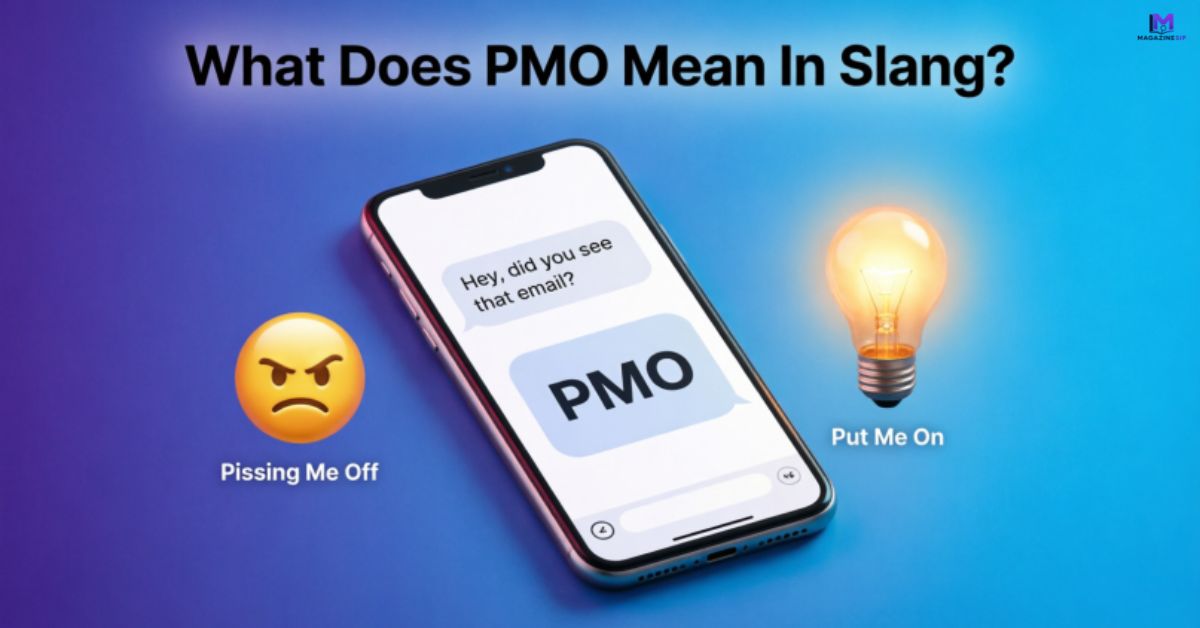
Seeing PMO in a message can be confusing because the same three-letter abbreviation can communicate two very different ideas. In everyday slang, PMO can be friendly when someone wants a recommendation, introduction, or useful information. It can also communicate frustration when something is irritating or annoying.
The easiest way to understand the PMO meaning is to look at the surrounding words, the tone, and the conversation itself. In texting, social media, group chats, and DMs, people rely heavily on context because internet slang often removes the extra words that would make an intended meaning obvious.
You may encounter PMO in TikTok comments, Instagram DMs, Snapchat messages, Discord conversations, gaming chats, Twitter/X posts, or casual text messages. One person may use it while asking for music recommendations, while another may use the same abbreviation during a rant about traffic, Wi-Fi, spoilers, or homework.
What Does PMO Mean?
The PMO meaning generally falls into two major categories: “Put Me On” and “Pisses Me Off.” “Put Me On” is usually a recommendation request or a request to introduce someone to something new. “Pisses Me Off” is an expression of frustration, annoyance, irritation, or anger.
When someone writes “pmo to that artist,” the intended meaning is usually “Put Me On,” meaning they want music recommendations or want someone to introduce them to the artist. A message such as “this traffic pmo” normally means “this traffic pisses me off.”
The surrounding words are therefore essential to PMO interpretation. A recommendation request, information request, or friendly expression normally points toward “Put Me On,” while a complaint, rant, or frustration statement normally points toward “Pisses Me Off.”
The PMO meaning in text can also depend on punctuation, capitalization, and tone. “Pmo to your playlist” sounds curious and friendly, whereas “slow Wi-Fi pmo” sounds irritated. Neither message needs a long explanation because casual communication depends on shared internet slang.
“Put Me On”
“Put Me On” is the positive and usually more conversational interpretation. The phrase can mean “introduce me,” “teach me,” “show me something good,” or “give me recommendations.” It often appears when someone wants to discover something new.
For example, a friend might say, “pmo to some good restaurants,” meaning they want restaurant recommendations. Someone interested in fashion might say, “pmo to your favorite brands,” while someone interested in entertainment might ask to be introduced to new TV shows, movies, songs, or artists.
The phrase “put me on to” is particularly useful because it shows the intended direction of the request. “Put me on to something” asks another person to share knowledge, while “put me on to someone” can mean introduce me to that person or connect me with them.
This version of the PMO meaning is closely connected to recommendations, culture, connections, knowledge, advice, and discovery. It can be used for music recommendations, show recommendations, product recommendations, skincare routines, clothing, outfits, brands, restaurants, date spots, accounts, creators, tips, and useful information.
A person might also use it when asking about a playlist, favorite music, favorite shows, favorite products, or a particular style. The tone is generally curious rather than angry.
Read More: GYG Meaning in Text: Why This 3-Letter Code Confuses Everyone
“Pisses Me Off”
The second major PMO meaning is “Pisses Me Off.” This version is used to express frustration, annoyance, irritation, or anger. It is often a short way to complain about an irritating behavior, annoying situation, or repeated inconvenience.
For example, “slow walkers pmo” communicates that slow walkers are irritating the speaker. “This Wi-Fi pmo” expresses frustration with slow Wi-Fi. Other casual examples could involve traffic, loud chewing, spoilers, delays, bad weather, homework, a vending machine, or someone leaving another person on read.
The expression is a mild form of profanity, so the tone can range from humorous complaining to genuine anger. It does not automatically mean that the writer is seriously furious. Friends often use the phrase casually while venting or joking.
This interpretation is especially common when the surrounding words describe an annoying situation. A rant video, complaint, angry social post, or frustrated message can make the intended meaning obvious.
The difference between the two interpretations is therefore important. “Put Me On” is normally a recommendation request or information request, while “Pisses Me Off” is normally a frustration statement or emotional reaction.
In unusual online contexts, PMO can have other adult meanings, so readers should not assume every occurrence has the same definition. In mainstream texting, social media slang, and casual communication, however, the two meanings above are the most relevant ones.
Origin and History of “PMO”
“Put Me On” has roots in Black American slang and Black American English, where the longer expression has been used to describe sharing knowledge, culture, connections, music, style, or useful information. To “put someone on” can mean helping that person discover something they did not previously know.
That cultural expression later fit naturally into internet slang and texting slang. As digital communication became faster, longer expressions were frequently shortened into abbreviations and acronyms. PMO became a convenient shorthand for “Put Me On.”
The “Pisses Me Off” interpretation developed through a similar language-shortening process. Internet forums, chat rooms, messaging, and informal written communication encouraged users to express common phrases quickly. Over time, PMO became recognizable as a compact way to communicate frustration.
Social media accelerated this process. TikTok, Instagram, Twitter/X, Snapchat, Discord, and other online communities gave slang terms a much wider audience. A phrase that once belonged to a particular conversational group could quickly become familiar across different internet communities.
The history of PMO therefore illustrates language evolution and language adaptation. Digital communication rewards expressions that are short, recognizable, and flexible. Texting culture and social media culture have made slang evolution especially rapid.
At the same time, language change can create ambiguity. Different generations, communities, and platforms can assign different meanings to the same abbreviation. That is why context and tone remain central to PMO interpretation.
How “PMO” Is Used on Different Platforms

“PMO” can have different meanings depending on the platform and context. On social media and messaging apps, it may mean “Put Me On,” “Piss Me Off,” or “Project Management Office.” Always check the surrounding conversation to understand the intended meaning.
TikTok
TikTok frequently uses PMO as a recommendation request. Someone may comment “pmo to your playlist,” “pmo to that skincare routine,” or “pmo to where you bought that outfit.” These comments usually have a friendly tone and ask the creator to share information.
TikTok comments can also use PMO in frustrated expressions. A creator may publish a rant video about bad weather, traffic, spoilers, or an annoying situation and use PMO to communicate irritation.
TikTok slang changes quickly, so the intended meaning should always be determined from the surrounding words.
Instagram DMs, Instagram Stories, Instagram captions, and social media comments can all contain PMO. A user might ask a creator to “pmo” to a clothing brand, restaurant, date spot, account, or product.
Instagram captions can also use PMO as an emotional reaction. A complaint about delays, traffic, or another irritating situation can use the abbreviation to signal annoyance.
Twitter/X
Twitter/X often favors short expressions because posts and replies move quickly. PMO may appear in a rant, complaint, reaction, or humorous post.
A user might write about spoilers, slow walkers, loud chewing, or another annoying situation. Recommendation threads can also use the abbreviation when people ask others to introduce them to artists, shows, accounts, or products.
Snapchat
Snapchat tends to encourage casual communication between friends. PMO can therefore appear in ordinary conversations, quick replies, and direct messages.
A friend might request new music, shows, restaurants, products, or fashion advice. Another person might use the same abbreviation while complaining about traffic or bad weather.
Discord and Gaming Chats
Discord and gaming chats use fast-moving informal language, so PMO fits naturally into online gaming and group conversations. A gamer might ask someone to “pmo” to a good build, game, server, strategy, or creator.
The frustrated version can appear when someone is annoyed by lag, a bad teammate, technical problems, delays, or another gaming problem. Gaming slang changes quickly, making context especially important.
| Platform | Common Use | Typical Tone | Example |
| TikTok | Recommendation request or reaction | Friendly or frustrated | “pmo to your playlist” |
| Requests, DMs, captions, or complaints | Mixed | “pmo to that brand” | |
| Twitter/X | Reactions and complaints | Often annoyed | “these delays pmo” |
| Snapchat | Casual requests or venting | Casual | “pmo to a good show” |
| Discord | Recommendations or gaming frustration | Context-dependent | “pmo to a good build” |
| Group chats | Recommendations or complaints | Casual | “pmo to some new music” |
| Gaming chats | Games, builds, or irritation | Fast and informal | “this lag pmo” |
| Social media comments | Information requests | Curious | “pmo to where you got this” |
Across these platforms, PMO usage is strongly influenced by the community. A creator’s audience may understand a slang abbreviation immediately, while someone outside that community may need additional context.
This is why PMO meaning on social media cannot be determined from the letters alone. TikTok comments, Instagram DMs, Instagram Stories, Twitter/X, Snapchat, Discord, gaming chats, and group chats all support slightly different conversational habits.
PMO in Texting vs. Real Life
PMO is primarily a texting abbreviation and internet expression. People are much more likely to type PMO in text messages, DMs, group chats, or online communities than to pronounce the letters during a real-life conversation.
In written communication, abbreviations save time. Someone can type “pmo to some good movies” instead of writing “put me on to some good movies.” Likewise, “this traffic pmo” is quicker than typing the complete frustrated phrase.
Spoken language usually works differently. In real-life conversation, people generally say “put me on to something” or “that pisses me off” rather than pronouncing P-M-O.
There can be exceptions. Someone familiar with internet culture might jokingly pronounce an abbreviation, but that is uncommon. PMO is primarily part of texting slang, chat slang, internet slang, and casual digital language.
The distinction also matters in formal communication. Workplace communication, professional communication, school communication, and formal settings generally favor complete expressions rather than slang abbreviations.
Examples of “PMO” in Sentences

GROUP 1 — Friendly/Casual
- “Pmo to some artists I should hear.”
- “I need a new playlist, pmo.”
- “Pmo to your favorite restaurants.”
- “Your outfits are great, pmo to those brands.”
- “Pmo to a good skincare routine.”
- “Pmo to some accounts worth following.”
- “I want to discover something new, pmo.”
- “Pmo to your favorite products.”
- “Can you pmo to a good hair stylist?”
- “Pmo to some shows for the weekend.”
These examples use PMO as “Put Me On.” The speaker is asking someone to share something, provide recommendations, or make an introduction.
GROUP 2 — Romantic/Flirty
- “You have good taste, pmo to your favorite date spots.”
- “Pmo to your favorite songs.”
- “You seem interesting, pmo to a movie you love.”
- “Pmo to that restaurant you mentioned.”
- “Pmo to your favorite place around here.”
- “You always find cool brands, pmo.”
In a romantic or flirty tone, PMO can be a low-pressure way to ask someone to share interests. It can create a natural conversation about music, restaurants, movies, fashion, or culture.
GROUP 3 — Sarcastic/Humorous
- “People who stop in the middle of the sidewalk pmo.”
- “My Wi-Fi choosing the worst possible time to fail pmo.”
- “When the vending machine takes my money, pmo.”
- “Traffic at rush hour pmo.”
- “People who spoil movies pmo.”
- “Slow walkers when I’m already late pmo.”
- “Loud chewing pmo so much.”
- “Getting left on read for three days pmo.”
These examples use the frustration interpretation. A sarcastic or humorous tone can make the complaint sound lighter than genuine anger.
GROUP 4 — Online/Caption Use
- “Pmo to creators who post useful tips.”
- “Pmo to accounts with good fashion advice.”
- “Pmo to underrated artists.”
- “This homework pmo but I’ll finish it.”
- “Monday delays pmo.”
- “Pmo to products that actually work.”
- “Pmo to restaurants worth trying.”
- “This weather pmo today.”
The intended meaning can usually be identified by the object following PMO. A request involving music, products, creators, brands, or restaurants usually suggests “Put Me On.” A complaint about traffic, homework, delays, weather, or people usually suggests “Pisses Me Off.”
Variations and Related Slang
PMO itself can appear in several capitalization styles. Users may write “PMO,” “pmo,” or “Pmo.” These forms generally do not change the underlying interpretation.
Some people also write the full expression “put me on,” especially when they want to make their meaning clearer. The phrase “put me on to” is another common form. “Plug me” can have a similar recommendation or connection function, although it is not identical in every situation.
Other slang abbreviations help explain how PMO fits into modern internet language. SMH means “Shaking My Head” and often communicates disappointment, disbelief, or disapproval. NGL means “Not Gonna Lie” and can introduce an honest opinion. ISTG means “I Swear To God” and can intensify a frustrated statement.
| Term | Meaning | Relationship to PMO |
| PMO | Put Me On / Pisses Me Off | Two major meanings |
| SMH | Shaking My Head | Often communicates disappointment |
| NGL | Not Gonna Lie | Can introduce an honest reaction |
| ISTG | I Swear To God | Can intensify frustration |
| Plug me | Connect or recommend something | Similar to “Put Me On” |
| Put me on | Introduce or recommend | Full expression of one PMO meaning |
| FAFO | A warning about consequences | Different meaning and use |
| IMO | In My Opinion | Marks an opinion |
| WYS | What You Say | Depends on conversational context |
| CM | Context-dependent abbreviation | Requires surrounding information |
PMO vs SMH is an especially useful comparison. SMH generally communicates disbelief, disappointment, or disapproval, whereas PMO can either request information or express active frustration.
PMO vs NGL is different because NGL usually introduces an honest statement rather than replacing the entire emotional reaction. “NGL, this pmo” can combine the two.
PMO vs ISTG is also straightforward. ISTG intensifies an emotional statement, while PMO itself supplies either the recommendation request or frustration expression.
“Plug me” is closer to the “Put Me On” interpretation because it can ask someone to make a connection or share information. However, “plug me” can sometimes imply access to a person, source, product, or opportunity rather than simply a recommendation.
These related slang terms show how internet acronyms, abbreviations, shorthand, and shortened phrases function in digital communication. Their interpretation depends on context, tone, and surrounding words.
Is “PMO” Safe for Kids?

The “Put Me On” interpretation is generally harmless. Children may use it while asking friends for music recommendations, show recommendations, product recommendations, fashion advice, or information about a creator.
The “Pisses Me Off” interpretation is different because it contains mild profanity. Families, teachers, and schools may have different standards regarding inappropriate language, even when the expression is being used casually.
For parents, the best approach is to consider the complete message rather than reacting to the abbreviation alone. Context can show whether a child is making a harmless recommendation request, using an emotional reaction, or encountering an adult meaning.
Parents should also remember that online slang can have multiple meanings. Some adult meanings of PMO appear in parts of the internet that are separate from ordinary social media slang. That does not mean every use has an adult meaning.
A parent guide should therefore focus on online safety, context, and communication rather than assuming that every abbreviation has the same definition.
Children, parents, and teachers may encounter PMO differently because age, platform, and social group affect slang interpretation. A child using PMO in school communication may simply be asking for recommendations, while an adult may interpret the same letters differently.
In school communication, formal settings, and workplace communication, spelling out the intended phrase is usually safer. Professional communication should prioritize clarity over trendy abbreviations.
When to Use (and Avoid) “PMO”
USE IT WHEN:
- Asking friends for music recommendations.
- Requesting show recommendations.
- Asking someone to introduce you to a creator or account.
- Requesting product recommendations.
- Asking about brands, outfits, clothing, or fashion.
- Looking for restaurants or date spots.
- Asking for a playlist or favorite music.
- Requesting skincare routine advice.
- Asking someone to share knowledge or tips.
- Looking for a hair stylist.
- Asking about a game, build, server, or strategy.
- Commenting casually on TikTok or Instagram.
- Messaging friends in DMs.
- Participating in group chats where everyone understands the slang.
- Venting about a small annoyance.
- Making a humorous complaint.
- Talking casually with people who already use internet slang.
- Joining a conversation where the tone clearly establishes the intended meaning.
- Asking someone to “put me on to something.”
- Asking someone to “put me on to someone.”
AVOID IT WHEN:
- Writing a professional email.
- Communicating with someone who may not understand modern slang.
- Speaking in a formal school setting.
- Writing workplace communication.
- Addressing customers or clients.
- Communicating with teachers when clarity is important.
- Writing an official document.
- Talking to someone who might interpret the abbreviation differently.
- The surrounding words do not make the intended meaning clear.
- A frustrated expression could be interpreted as disrespectful.
- Mild profanity would be inappropriate.
- The audience includes people unfamiliar with texting slang.
- A recommendation request could be misunderstood as a complaint.
- A complaint could be misunderstood as a recommendation request.
- You need precise written communication.
- You are discussing a sensitive issue where tone matters.
The safest rule is simple: use PMO when the conversation is casual and the audience understands the slang. Avoid it when ambiguity could create confusion or when professional communication requires maximum clarity.
Conclusion
The PMO meaning depends on context, tone, and surrounding words. In everyday internet slang, PMO most commonly means “Put Me On” when someone wants recommendations or an introduction, or “Pisses Me Off” when someone is expressing frustration.
Because the abbreviation can carry opposite emotional meanings, readers should examine the complete message before deciding what the writer intended. TikTok, Instagram, Twitter/X, Snapchat, Discord, DMs, and group chats can all use PMO differently.
Understanding slang is largely about recognizing conversational context. Once you know whether the speaker is requesting information or expressing irritation, the intended meaning becomes much easier to identify.
FAQ
What is PMO in English slang?
PMO is commonly used in English slang with two meanings: “Put Me On” and “Pisses Me Off.” “Put Me On” is generally a recommendation request or request for an introduction, while “Pisses Me Off” expresses frustration or annoyance.
What is PMO slang for a girl?
There is no separate universal meaning of PMO specifically for a girl. A girl can use PMO with the same meanings as anyone else: “Put Me On” or “Pisses Me Off.”
What is a PMO in TikTok?
On TikTok, PMO commonly appears in comments asking someone to share recommendations, information, products, music, creators, accounts, or other discoveries. In that setting, “Put Me On” is often the intended interpretation.
Is PMO a bad word in slang?
PMO itself is not automatically a bad word. The “Put Me On” meaning is generally harmless. The “Pisses Me Off” meaning contains mild profanity, so some people may consider it inappropriate in certain family, school, or professional environments.
What is PMO in TXT?
In a TXT or text-message conversation, PMO usually means either “Put Me On” or “Pisses Me Off.” The intended meaning depends on the words around the abbreviation.
