

If someone replies “cap 🧢” to your message, they are usually saying they do not believe you. In modern slang, cap can point to a lie, an exaggerated statement, a doubtful claim, or something that sounds too good to be true. The exact Cap Meaning depends on the conversation, relationship, tone, and context.
You may see cap in texting, TikTok comments, Instagram DMs, Discord chats, Reddit discussions, and everyday conversations. The expression can be playful between friends or more confrontational when someone is seriously challenging another person’s credibility. Understanding that difference is important because the same short reply can communicate teasing, skepticism, disbelief, or accusation.
The phrase “no cap” works in the opposite direction. When someone says “no cap,” they are emphasizing honesty and saying they are being serious or truthful. The expression has become part of internet slang and youth slang, while its roots are connected with African American English and Black American speech.
What Does Cap Mean?
The simplest Cap Meaning is “a lie” or “an exaggeration.” When somebody says “that’s cap,” they are saying that a claim is false, unbelievable, or not genuine. In everyday slang, cap can therefore act as a quick accusation of lying without requiring a long explanation.
For example, imagine a friend says, “I ran a six-minute mile without training.” You might answer, “Cap.” That reply communicates disbelief. You are not necessarily calling your friend a serious liar; depending on the relationship, you could simply be teasing them because their story sounds exaggerated.
The meaning of cap is strongly connected with honesty and credibility. A person who says “you’re capping” believes the other person is exaggerating, inventing a story, or making a false claim. The phrase “stop capping” makes the accusation even more direct.
“No cap” reverses the message. If somebody says, “No cap, that was the best concert I’ve ever seen,” they are emphasizing that they genuinely mean it. In this context, no cap is close to “for real,” “seriously,” or “I’m not lying.”
The 🧢 emoji can communicate the same idea. A person might post only “🧢” beneath a social media comment, and readers understand it as a visual shorthand for calling out something they consider fake or untrue.
The tone matters. Among friends, cap can be playful teasing. During an argument, it can sound dismissive or hostile. Context determines whether the expression is light banter, skepticism, humor, or a genuine accusation.
A quick comparison
| Expression | Typical meaning | Common tone |
| cap | A lie, exaggeration, or unbelievable claim | Skeptical |
| that’s cap | I don’t believe that | Direct |
| you’re capping | You are lying or exaggerating | Accusatory |
| stop capping | Stop lying or exaggerating | Strong |
| no cap | I’m being honest | Serious or emphatic |
| 🧢 | That sounds fake or false | Visual, quick, playful |
| hard cap | An especially unbelievable claim | Strong disbelief |
A useful way to remember the Cap Meaning is simple: cap challenges truth, while no cap reinforces truth.
Origin and History of “Cap”
The origin of cap is more complicated than the idea that it was invented by TikTok or Gen Z. The modern expression is associated with African American Vernacular English, African American English, Black American speech, and Black American culture. It later spread widely through hip-hop, rap, social media, and internet culture.
The history of cap is therefore tied to a broader linguistic history rather than one single website or platform. Capping has been associated with bragging, exaggeration, and claims that are not entirely genuine. Over time, the expression developed into a common way of challenging someone’s honesty.
Hip-hop culture played an important role in bringing expressions such as “no cap” to a much wider audience. During the 2010s, rappers and hip-hop artists used the phrase frequently, helping move it from community speech into mainstream youth culture. Future and Young Thug are particularly associated with the phrase through their music, including the 2017 track “No Cap.”
By the late 2010s, internet culture had accelerated the spread. Social media users adopted cap in comment sections, captions, direct messages, and online arguments. TikTok later helped make the expression familiar to an even broader audience.
This history is worth remembering because slang does not simply appear from nowhere. Words can emerge in communities, gain meaning through repeated social use, move into music, and eventually become mainstream internet language.
The modern Cap Meaning still reflects that history. Although people from many backgrounds now use cap, its development is connected with Black American speech and cultural expression. Treating that history respectfully is more useful than describing cap as a random Gen Z invention.
Read More: What Does BBG Mean in Slang? Here Is the Real Meaning
How “Cap” Is Used on Different Platforms
Different platforms encourage slightly different forms of slang. The basic Cap Meaning stays recognizable, but tone and frequency can change according to the community.
TikTok
TikTok is one of the places where cap appears most visibly. Users may respond to a storytime video with “cap,” “that’s cap,” or a series of 🧢 emojis when they think the story sounds exaggerated.
Creators can also use “no cap” to emphasize that a surprising story is genuine. For example: “No cap, I met my favorite artist at the grocery store.”
The phrase is especially common in social media comments because it is short and immediately understandable. TikTok also encourages fast reactions, making visual shorthand such as the cap emoji particularly useful.
On Instagram, cap appears in Instagram DMs, Stories, captions, replies, and comment sections. Friends might use it when challenging an exaggerated claim, while creators may use no cap as emphasis.
Example: “You said you were staying home tonight. 🧢”
Another example is: “This restaurant is incredible, no cap.”
Here, the Cap Meaning depends heavily on context. The first example challenges a claim, while the second reinforces sincerity.
Twitter/X
Twitter/X is well suited to short expressions of disagreement. Someone can quote a post and simply write “cap” to signal that they think the original claim is false or misleading.
Because conversations can become argumentative quickly, cap may sound sharper on Twitter/X than it does in a private group chat. A one-word response can communicate skepticism without explaining the reason.
Snapchat
Snapchat often uses cap as casual friend-group slang. Someone who claims they are going to bed but then uploads a party Story could easily receive “you’re capping” as a joking response.
The expression works well in Snapchat streaks and group conversations because the participants usually understand one another’s tone.
Discord and gaming chats
Gaming communities use cap when players brag about stats, plays, rankings, or competitive achievements. If someone says they won a difficult 1v5, another gamer might respond, “Hard cap. Show the clip.”
Here, cap can become part of trash talk and competitive banter. Gamers may use “cap until proven” when they want evidence for an impressive claim.
Reddit uses cap less consistently than TikTok or some chat platforms, but it still appears in casual communities. A dramatic story in an AITA discussion or relationship thread may attract comments saying “this is cap” when readers believe the story is fabricated or exaggerated.
| Platform | Common use | Typical tone |
| TikTok | Challenging stories and claims | Playful or skeptical |
| DMs, Stories, captions | Casual | |
| Twitter/X | Disagreement and quote tweets | Direct |
| Snapchat | Friend-group teasing | Light |
| Discord | Gaming claims and bragging | Competitive |
| Doubting dramatic stories | Skeptical | |
| YouTube | Challenging comments or claims | Mixed |
| Group chats | Calling out friends | Playful |
Platform comparison
The important point is that the Cap Meaning does not radically change from one platform to another. What changes is the social setting, the relationship between participants, and the tone surrounding the expression
Cap in Texting vs. Real Life
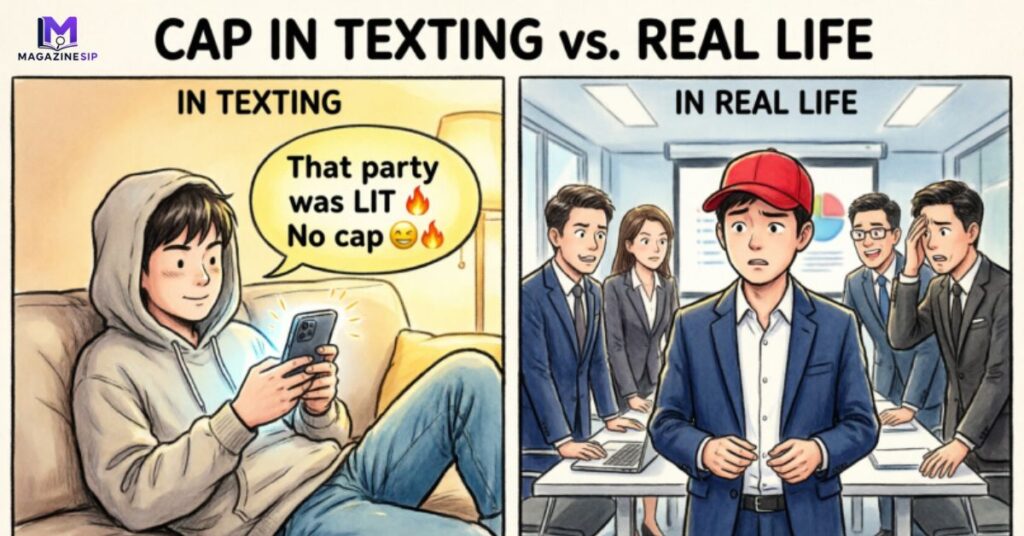
Cap in texting is especially efficient because one short word can communicate disbelief. A friend can send “cap” without explaining that they think your story is exaggerated. The recipient is expected to understand the social shorthand.
In spoken slang, the same expression depends more on delivery. Someone saying “cap” with a laugh may be joking. Someone saying “That’s cap” during an argument may be seriously challenging the other person’s credibility.
The phrase “no cap” works naturally in both spoken and written communication. A person might say, “No cap, I was nervous,” or type “no cap” at the end of a message. In both cases, the phrase emphasizes sincerity.
Texting also makes the 🧢 emoji useful. The emoji can replace the word entirely, especially when somebody wants a quick reaction. Multiple cap emojis can make the response feel even more emphatic.
The difference between texting and face-to-face conversation is therefore mostly about tone. Written slang lacks facial expressions and vocal delivery, so context, punctuation, emojis, and the existing relationship between speakers become more important.
Examples of “Cap” in Sentences
Examples make the Cap Meaning easier to understand because the expression can sound different depending on the situation.
GROUP 1 — Friendly/Casual
“You ate the whole pizza by yourself? That’s cap.”
“No cap, that movie was actually amazing.”
“You said you were going to clean your room yesterday. Stop capping.”
“I’m not capping; the concert really was that good.”
“No cap, I have never seen that many people at one party.”
“You’re capping if you think you can finish all that food.”
GROUP 2 — Romantic/Flirty
“No cap, you look great tonight.”
“You said you weren’t jealous, but that sounds like cap.”
“I’m being honest, no cap.”
“Was it cap when you said you missed me?”
“No cap, your message made my whole day.”
GROUP 3 — Sarcastic/Humorous
“I’m going to the gym every morning now.”
“Cap. You said that last week.”
“I’m only eating one slice.”
“That’s the biggest cap I’ve heard today.”
“I’ll go to bed early tonight.”
“Sure. Stop capping.”
GROUP 4 — Online/Caption Use
“Finally got the promotion. Hard work really pays off, no cap.”
“Best pizza in the city, no cap.”
“Y’all believe this story? 🧢”
“This gaming clip is crazy. No cap.”
“Someone tell him he’s capping.”
GROUP 5 — Gaming
“I hit diamond in solo queue.”
“Cap. Show the stats.”
“I clutched a 1v5.”
“Hard cap until we see the replay.”
“I’m not capping, that was my cleanest play.”
GROUP 6 — Everyday Claims
“I walked ten miles before breakfast.”
“Cap.”
“I finished the entire project in one night.”
“You’re capping.”
“I’m telling the truth, no cap.”
These examples demonstrate that cap is not always a serious accusation. It can be teasing, skepticism, sarcasm, disagreement, or playful banter. The surrounding conversation tells you which interpretation makes sense.
Variations and Related Slang
The most common variations include cap, capping, capped, no cap, and the 🧢 emoji.
- Cap — the basic expression for a lie or exaggerated claim.
- Capping — the action of lying or exaggerating.
- Capped — describing something that was exaggerated or untrue.
- No cap — an honesty marker meaning seriously or for real.
- You’re capping — directly telling someone that you believe they are lying.
- Stop capping — telling someone to stop exaggerating.
- Cappin — an informal spelling often seen in casual writing.
- 🧢 — visual shorthand for cap.
- Kap — an occasional stylistic spelling.
- Hard cap — strong disbelief in a claim.
Some related slang terms help explain the wider semantic field.
Sus
Sus means suspicious or sketchy. Something suspicious may lead someone to question a claim and eventually call it cap.
Based
Based often describes someone who is unapologetic or authentic. In some contexts, it contrasts with capping because the speaker is presenting themselves as genuine.
NGL
NGL means “not gonna lie.” Like no cap, it can introduce an honest opinion. Someone might write, “NGL, no cap, that was incredible.”
Mid
Mid generally describes something average or mediocre. If one person calls a movie mid while another calls it the greatest film ever made, the second person might jokingly accuse them of capping.
| Term | Meaning | Relationship to cap |
| Cap | Lie or exaggeration | Core term |
| No cap | Honest or serious | Opposite |
| Sus | Suspicious | Related |
| Based | Authentic or unapologetic | Contrasting idea |
| NGL | Not gonna lie | Similar honesty marker |
| Mid | Average or mediocre | Different meaning |
| SMH | Expressing disappointment | Different function |
| ISTG | I swear to God | Can emphasize sincerity |
The Cap Meaning is easiest to understand when these related expressions are separated rather than treated as exact synonyms.
Is “Cap” Safe for Kids?
Cap is generally considered ordinary slang rather than profanity. The expression itself is not inherently sexual, violent, or obscene, so children and teenagers may encounter it in texting, gaming, school conversations, and social media.
However, calling another person a liar can still create conflict. A child who repeatedly says “that’s cap” to classmates may sound dismissive, rude, or confrontational even when the slang itself is harmless.
Parents and teachers can explain that slang etiquette depends on audience and context. Saying “cap” to a close friend may be playful, while saying it to a teacher during a disagreement could sound disrespectful.
The same principle applies to online communication. Kids may see cap in TikTok comments, Discord chats, YouTube comments, or group chats without fully recognizing the difference between joking and confrontation.
A useful parent guide is to focus less on banning the word and more on teaching children when casual language is appropriate. The Cap Meaning is simple, but the social effect can change dramatically depending on how and where it is used.
When to Use (and Avoid) “Cap”
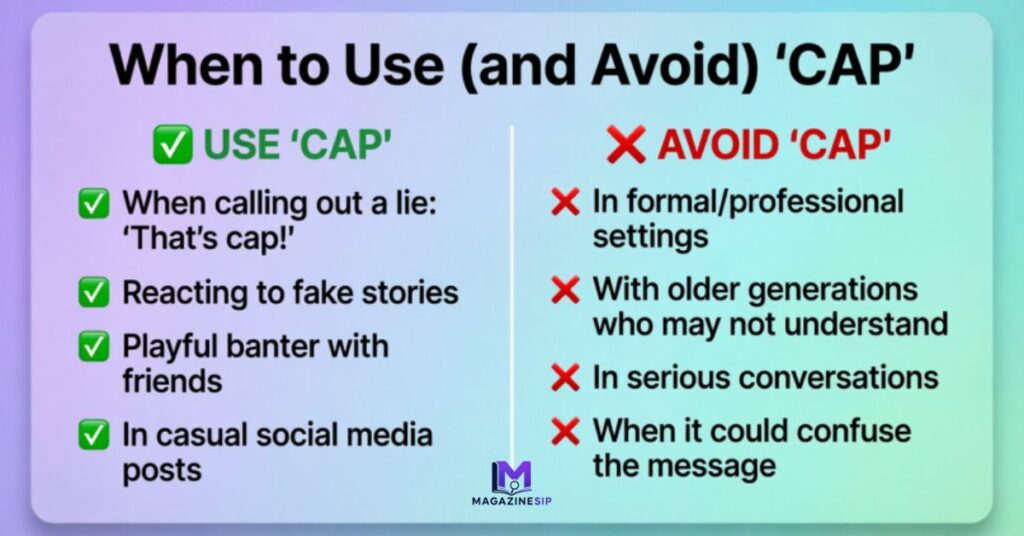
USE IT WHEN:
- You are joking with friends who understand the expression.
- You are using casual texting slang.
- You want to challenge an obviously exaggerated story.
- You want to say no cap when emphasizing honesty.
- You are participating in a familiar online community.
- You are replying casually in a group chat.
- You are using the 🧢 emoji with people who understand its meaning.
- You are engaging in playful gaming banter.
- You are writing an informal social media caption.
- You know the other person’s tone and communication style.
AVOID IT WHEN:
- You are writing a formal work email.
- You are in a job interview.
- You are communicating with someone unfamiliar with slang.
- You need to make a serious accusation carefully.
- The person could interpret the statement as disrespectful.
- You are handling a sensitive disagreement.
- You are communicating in a formal school or professional setting.
- You need precise language rather than casual shorthand.
- The conversation involves an important false claim that requires evidence.
- You are unsure whether the other person understands the expression.
The key issue is not whether cap is inherently rude. It is whether the expression fits the audience and situation. Casual language works best when everyone involved understands the social rules.
What does cap mean in slang hidden meaning revealed urban
In urban slang and modern African American English, cap is commonly associated with lying, exaggeration, or making an unbelievable claim. The expression can function as a quick way to question whether something is genuine.
The Cap Meaning can also shift from a direct accusation to friendly banter. A close friend saying “cap” may simply be teasing, while the same word from a stranger may feel dismissive or confrontational.
What does cap mean in slang hidden meaning revealed tik
On TikTok, cap is frequently used in comments when viewers believe a story, claim, or reaction is exaggerated. The 🧢 emoji can serve as a faster visual response when users do not want to type a complete sentence.
The Cap Meaning on TikTok remains connected to disbelief and honesty, but creators also use no cap to emphasize that an unusual story is genuine. Context is especially important because humorous comments can look like serious accusations.
Cap meaning slang origin
The slang origin of cap is connected with African American English and Black American speech rather than beginning with TikTok. Hip-hop and rap helped spread related expressions during the 2010s, after which internet culture accelerated their mainstream visibility.
The modern Cap Meaning developed through repeated community use and cultural exchange. Understanding that background helps explain why describing cap as merely “Gen Z slang” leaves out an important part of its linguistic history.
What is a cap slang Drug
The word cap can have unrelated meanings outside slang about dishonesty. In some contexts, people may encounter “cap” in discussions involving drugs, but that does not mean every use of cap refers to drugs.
For everyday texting and social media, the Cap Meaning discussed in this article is about lying, exaggerating, disbelief, or honesty. Context should always be used to determine which meaning applies.
I had a cap meaning
If someone says “I had a cap” without additional context, the phrase can be ambiguous because cap has several literal and slang meanings. The surrounding sentence is necessary to identify the intended sense.
In ordinary internet slang, however, cap usually relates to dishonesty or exaggeration. The Cap Meaning becomes clearer when you look at the speaker’s complete message rather than interpreting the isolated word.
Why does cap mean lie
The expression developed through slang usage associated with claims that were exaggerated, boastful, or not genuine. Over time, calling something cap became a concise way to reject it as false or unbelievable.
That is why “you’re capping” means that someone is allegedly lying or exaggerating. The Cap Meaning is essentially a social judgment about whether a statement deserves to be believed.
When to Use (and Avoid) “Cap”

“All cap” generally intensifies the idea that something is completely false, exaggerated, or dishonest. It can be used when a speaker believes that none of a particular story should be trusted.
The phrase is still dependent on context. Someone might say “that’s all cap” as playful teasing, while another speaker could use it during a serious disagreement. Tone determines how strong the accusation feels.
What does stop the cap mean in slang
“Stop the cap” means something like “stop lying,” “stop exaggerating,” or “stop making claims I don’t believe.” It is a more forceful variation of “stop capping.”
The phrase may appear in social media comments, gaming chats, or casual conversations. Like other forms of cap slang, its exact force depends on the relationship between the speakers.
Conclusion
Cap is a compact piece of modern slang used to challenge a claim, express disbelief, or accuse someone of exaggeration. No cap moves in the opposite direction by emphasizing honesty, sincerity, and seriousness.
Understanding the expression also means understanding context, tone, and cultural history. Whether it appears in texting, gaming, TikTok comments, or everyday speech, the intended message is usually clear once you know how cap and no cap work together.
FAQ’s
What does cap slang mean?
Cap slang usually means a lie, exaggeration, or claim that the speaker does not believe. If someone says “that’s cap,” they are challenging the truthfulness of what was said.
The expression can be serious or playful. Friends may use it for teasing, while strangers may use it as a direct accusation. The surrounding context determines the tone.
Why does Gen Z say cap?
Gen Z uses cap because it is short, expressive, and easy to understand in digital communication. It works especially well in comments, group chats, memes, gaming communities, and social media conversations.
Although it became highly visible among younger internet users, its history is broader than Gen Z culture. The expression has connections to African American English and was popularized more widely through hip-hop and later internet culture.
Why is saying cap considered lying?
When someone says “cap,” they are generally claiming that another person’s statement is false, exaggerated, or unreliable. The person being called cap may therefore be accused of lying.
However, cap does not always mean the speaker believes a serious deception occurred. Among friends, it can simply be humorous skepticism or playful teasing.
Where does the term “cap” originate from?
The modern slang use of cap is associated with African American Vernacular English and Black American speech. Its development predates TikTok and became more widely recognized through Black culture, hip-hop, rap, and later social media.
Its history illustrates how slang can move between communities and media. A term can develop within a particular speech community before becoming familiar to a much larger audience.
When did the term “no cap” originate?
“No cap” became especially prominent in mainstream hip-hop and internet culture during the 2010s. Future and Young Thug’s 2017 song “No Cap” is one notable example of the phrase’s visibility during that period.
The phrase subsequently spread rapidly through social media and youth culture. Today, no cap is commonly used to emphasize that someone is being sincere, serious, or truthful.
