

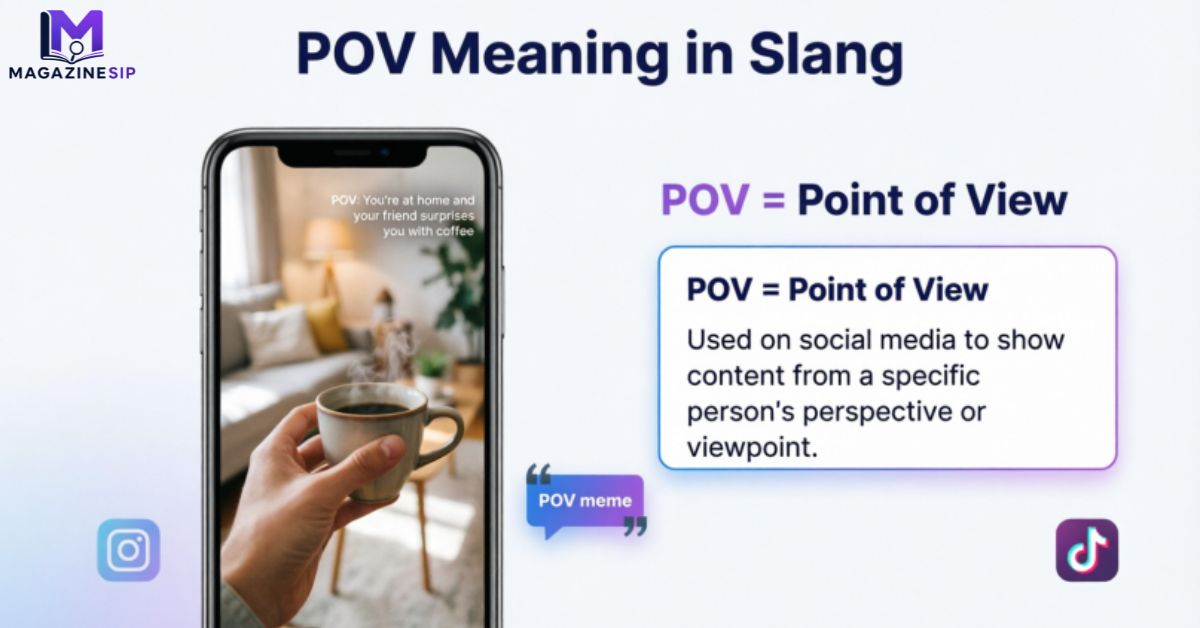
If you have ever seen “POV:” at the start of a TikTok, caption, meme, or text, you have probably wondered what the writer expects you to imagine. The short answer is that POV stands for “point of view,” but modern slang gives the expression a wider job.
Today, POV can introduce a scenario, frame a relatable moment, establish a viewpoint, or invite the audience into an imagined experience. Its exact meaning depends on context, platform, tone, and the kind of content surrounding the phrase.
This guide explains the literal definition, modern internet usage, social media examples, texting habits, filmmaking background, related slang, safety considerations, and practical ways to use the expression naturally.
What Does POV Mean?
POV Meaning is easiest to understand when you separate the traditional definition from modern slang. POV means “point of view,” or the position from which someone sees, describes, or experiences a situation. In everyday online usage, the phrase can also introduce an imagined scenario.
The traditional point of view describes a perspective or viewpoint. In literature, a narrator may tell a story through first-person narration, while filmmaking can use a POV shot to show a character’s eyes. In social media slang, however, POV often functions as shorthand for “imagine this” or “put yourself in this situation.”
For example, “POV: You finally finish your homework on Sunday night” creates a hypothetical scenario. The reader is not necessarily watching through a literal camera angle. Instead, the caption establishes a scenario setup and asks the audience to recognize the experience.
That distinction explains why modern POV content can show a creator’s face rather than an actual first-person view. The creator is using perspective framing to communicate a situation, reaction, feeling, or joke rather than claiming technical accuracy.
POV Meaning also changes with tone. A friendly post can create a warm relatable moment, while sarcastic content can exaggerate a situation. Romantic content can frame a crush or long-distance partner, and dramatic content can create emotional tension.
The expression is therefore more flexible than its original technical definition. It remains connected to point of view, but modern usage emphasizes imagination, context, and shared experience.
Origin and History of “POV”

POV Meaning has roots in filmmaking, literature, and storytelling rather than social media alone. The abbreviation represents point of view, a concept that helps creators decide whose perspective the audience receives.
In film, a POV shot can place the audience behind a character’s eyes. A camera angle may reproduce what the character sees, allowing the audience to share the character perspective. Horror movies frequently use this filmmaking technique because seeing through character’s eyes can make a scene feel immediate.
Writing uses a related idea. First-person POV normally places the reader close to a narrator who describes events using “I” or “we.” First-person narration can reveal thoughts, emotions, memories, and lived experience directly. Creative writing and literature have used perspective choices for centuries.
The internet expanded the idea. Early videos often used genuine first-person gameplay, helmet cameras, action cameras, or other visual techniques to simulate a character’s viewpoint. Gaming channels also helped normalize first-person gameplay as an everyday form of visual storytelling.
Later, social platforms made the term much more flexible. Short videos needed quick ways to establish context, so a creator could put “POV:” on screen and immediately tell viewers what scenario to imagine.
TikTok culture accelerated this language evolution. Creators discovered that POV could introduce TikTok skits, emotional content, comedy, dramatic content, and relatable content without requiring a technically accurate camera perspective.
This is an example of language evolution and semantic shift. A term can retain its literal meaning while gaining an expanded meaning through modern usage. Internet culture frequently creates these language shifts because millions of people repeat expressions in new contexts.
The development also shows why technical accuracy and modern usage can differ. In filmmaking, a POV shot has a relatively precise function. In online communication, POV can simply be a shorthand expression for a situation.
POV Meaning therefore has two connected histories: the technical history of point of view in filmmaking and literature, and the informal history of scenario-based communication on social media.
How “POV” Is Used on Different Platforms
POV Meaning is not identical across every platform. The same abbreviation can feel dramatic on TikTok, casual on Instagram Stories, sarcastic on Twitter/X, personal on Snapchat, or playful in Discord gaming chats.
TikTok
TikTok is one of the strongest homes for modern POV slang. A POV TikTok may present a fictional scene, character acting, reaction, joke, emotional content, or scenario-based content.
A creator might write:
“POV: Your mom asks whether you studied, and you suddenly remember the entire semester.”
The visual setup may show the creator playing a student, while the audience imagines being in the situation. This is short-video storytelling rather than literal first-person filmmaking.
POV videos can be friendly, sarcastic, romantic, humorous, dramatic, or mocking. TikTok skits especially depend on quick scenario setup because viewers have only a few seconds to understand the premise.
Instagram uses POV through Instagram Reels, Instagram Stories, photos, captions, and social media posts. Instagram Reels often borrow the fast visual language popularized by TikTok, while Instagram Stories can use POV for more personal situations.
A creator could post:
“POV: You booked the airport trip you kept talking about.”
The caption establishes an aspirational scenario. The photo or video does not have to be filmed from the viewer’s literal eyes.
Twitter/X
Twitter/X often uses POV in text rather than performance. A user can create a hypothetical situation with a single sentence and let the reader supply the imagination.
For example:
“POV: The recruiter wants five years of experience for an entry-level job.”
The format works because the scenario is recognizable. The writer does not need a POV video or elaborate visual setup.
Snapchat
Snapchat tends to use POV in casual Stories and personal communication. Someone might write:
“POV: It’s Sunday night and the homework still exists.”
Here the expression creates a relatable moment rather than a technical viewpoint.
Discord/Gaming Chats
Discord uses POV in gaming chats, memes, jokes, and in-game scenarios. Gamers may use it while roasting teammates or describing gameplay.
For example:
“POV: You’re our tank and just walked into the enemy team alone.”
The point is not necessarily that the reader sees the game through the tank’s camera. The phrase frames the situation from the teammate’s perspective.
| Platform | Common use | Typical tone | Example |
| TikTok | POV TikTok, skits, videos | Dramatic or comedic | “POV: You forgot the assignment.” |
| Reels, Stories, captions | Relatable or aspirational | “POV: You finally booked the trip.” | |
| Twitter/X | Text jokes and commentary | Sarcastic or observational | “POV: Your boss sends an email at 5:01.” |
| Snapchat | Stories and casual posts | Friendly and casual | “POV: Monday arrived.” |
| Discord | Gaming chats and memes | Playful or mocking | “POV: You forgot to mute.” |
POV Meaning can therefore be understood through platform context. Social media slang does not always preserve the formal definition, but the underlying idea of perspective remains recognizable.
Pov meaning in chat
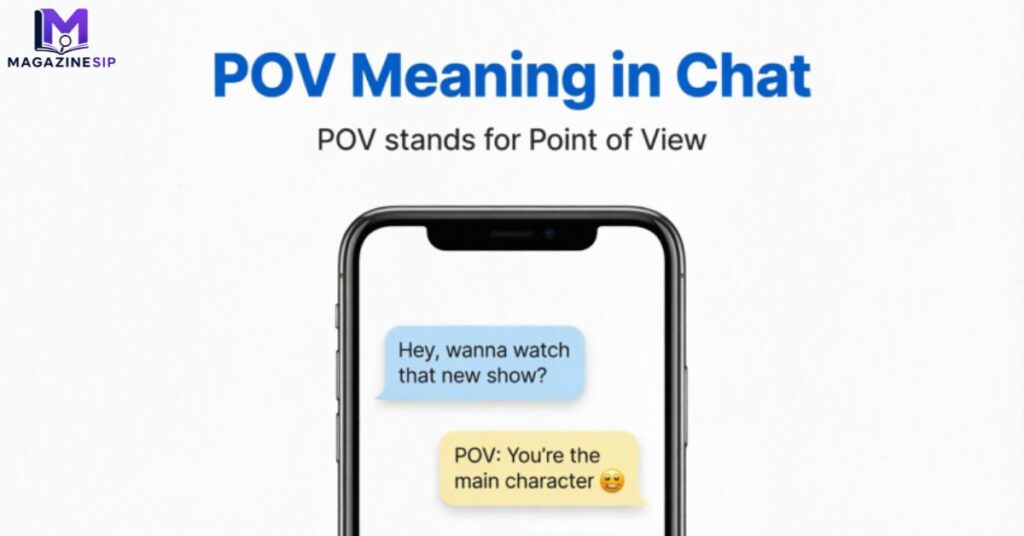
POV Meaning in chat usually works as a compact scenario prompt. A person can type “POV:” before a joke, reaction, imagined situation, or relatable experience and expect the other person to understand the setup quickly.
For example, a friend might send, “POV: You open the fridge for the fourth time hoping new food appeared.” This is casual conversation, not formal writing. The phrase creates a shared imagination between people in an online chat.
Another useful feature is speed. Text messages often need shorthand because people want to communicate reactions without writing a long explanation. POV can supply context with only three letters.
In group chat conversations, POV may also become part of memes or commentary. Friends can use it to tease one another, describe a personal relatable moment, or turn an ordinary situation into a joke.
POV Meaning in chat is therefore close to “imagine this,” although the exact effect depends on the situation. It can be sincere, sarcastic, humorous, romantic, or playful.
POV means in Instagram
On Instagram, POV Meaning usually appears in captions, Instagram Reels, Instagram Stories, photos, and short videos. The expression tells viewers how to interpret what they are seeing.
A Reel might show someone walking into a gym with the caption, “POV: You finally found motivation.” The video is not necessarily a literal camera representation of the viewer. Instead, the caption provides perspective framing.
Instagram creators also use POV for aspirational content. A photo of an airport, restaurant, concert, or vacation can receive a caption that turns an ordinary image into a hypothetical scenario.
POV Meaning in Instagram can also be humorous. A creator may use exaggerated character acting to present a situation that viewers recognize from real life.
What is POV means in social media
POV Meaning on social media is generally “point of view,” but modern social media slang often uses it as a scenario-setting phrase. It can mean “imagine this,” “suppose you are here,” or “this is what the situation feels like.”
The important word is context. A filmmaking student may use POV to describe a technical camera position. A TikTok creator may use the same abbreviation to introduce comedy. A writer may use first-person POV to describe narration.
Social media posts frequently depend on shared recognition. When a caption says “POV: Monday morning,” the audience supplies the details from personal experience. The writer provides the framing, while the reader supplies the imagination.
That is why POV works so well for relatable content. It is an efficient language function: a short phrase creates a situation, establishes a viewpoint, and invites a reaction.
POV means in memes
POV Meaning in memes is often playful rather than technically precise. Meme creators use the expression to establish a recognizable moment and then deliver a reaction, punchline, photo, or short video.
A meme could say:
“POV: You said you would watch one episode.”
The image might show someone awake at 3 a.m. after Netflix-style binge watching. The phrase creates the setup, while the image supplies the reaction.
Memes also combine POV with internet slang such as NGL, IMO, IYKYK, TFW, Me when, This gives, Based, and SMH. These expressions have different functions, but they all help people communicate tone quickly.
Read More: What Does Fein Mean In Slang? Full Guide
POV meaning TikTok
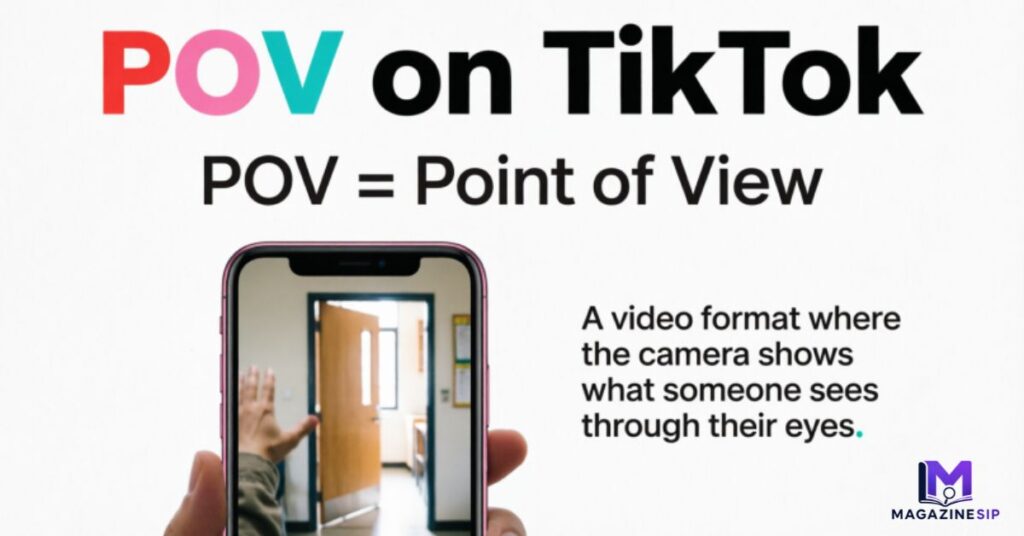
POV Meaning on TikTok is strongly associated with scenario-based videos. A POV video may feature character acting, comedy, emotional content, dramatic content, or sarcastic content.
The creator may perform several characters, act as a friend, imitate a teacher, play a boss, or portray a fictional character. The viewer is encouraged to understand the situation from the framing supplied by the creator.
Why people use POV on TikTok is simple: it gives a video an immediate premise. Why TikTok uses POV so heavily is also connected to short-video storytelling. Viewers can understand the setup almost instantly.
A POV TikTok can be as simple as:
“POV: Your crush finally replies.”
Or:
“POV: The teacher says the test is easy.”
These examples rely on shared experience, not a literal camera angle.
POV means in reels
POV Meaning in Reels follows the same general pattern as TikTok usage. Instagram Reels creators use POV to establish a scenario before the visual action begins.
The caption may introduce a situation involving a friend group, middle child, boss, crush, gym, airport, recruiter, or toxic ex. The video then acts out the scenario.
Because Reels are short videos, the scenario setup needs to be concise. A POV caption can perform that job immediately.
POV also works with aspirational and observational content. A creator may write “POV: You finally leave the job you hate” over travel footage, or “POV: Your Sunday motivation disappears” over a comedic scene.
POV meaning in video
POV Meaning in video depends on whether the video uses a technical POV shot or modern social media slang.
A true POV shot attempts to represent what a character sees. The camera angle is positioned to create a first-person visual experience. This is common in film, horror movies, action sequences, and first-person gameplay.
A social media POV video can be much looser. The creator may face the camera directly while acting out a scenario. In that setting, POV means that the audience should imagine occupying the role described in the caption.
The distinction matters when discussing filmmaking technique. In professional film language, technical accuracy matters more than it does in internet slang.
POV meaning vehicle
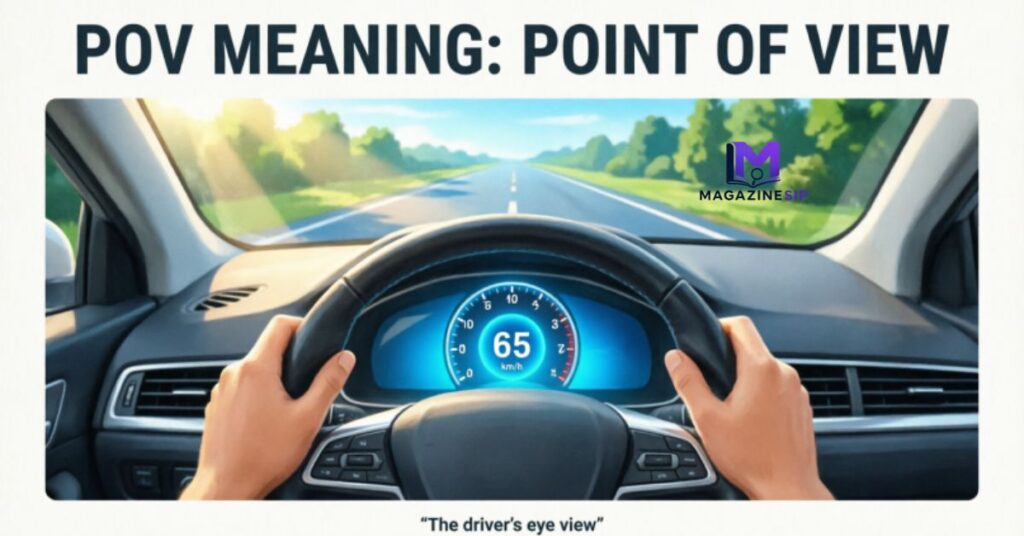
In a vehicle context, POV Meaning can describe a camera or recording position that shows what a driver or passenger sees. Dashcam footage, motorcycle recordings, cycling videos, and driving simulations can all use a first-person viewpoint.
For example, a driving video may show a road from the driver’s position. That is closer to the traditional point of view definition because the visual framing represents the experience of the person operating the vehicle.
Online creators can also add “POV” to a vehicle video simply to create a scenario. “POV: You finally get your dream car” is not necessarily a technical description of camera placement.
The surrounding context therefore determines whether POV is being used as a filmmaking term, a video description, or social media slang.
POV in Texting vs. Real Life
POV Meaning is especially common in texting because written language makes scenario framing easy. A person can type “POV:” followed by a situation and let the reader visualize it.
For example:
“POV: You are pretending to understand the group project.”
The recipient immediately understands the joke because the phrase establishes a situation.
In spoken language, the expression can sound more internet-oriented. Someone can still say POV aloud, especially when discussing memes or TikTok culture, but ordinary spoken language often uses phrases such as “imagine this” instead.
This difference reflects language function. Written language supports shorthand, captions, and visual framing particularly well, while spoken language often favors a more natural conversational setup.
POV Meaning in texting is therefore a practical form of informal communication. It is useful when a person wants to communicate a scenario, reaction, feeling, or joke without a long explanation.
Examples of “POV” in Sentences
GROUP 1 — Friendly/Casual
- “POV: Your friend group finally agrees on where to eat.”
- “POV: Your mom calls you for dinner while you are playing a video game.”
- “POV: Your boss sends an email five minutes before the weekend.”
- “POV: Monday arrives before you are ready.”
- “POV: Sunday gives you one last peaceful hour.”
These examples use POV as casual shorthand. They create a relatable moment and depend on common experience.
GROUP 2 — Romantic/Flirty
- “POV: Your crush likes your photo.”
- “POV: Your long-distance partner appears at the airport.”
- “POV: They answer your message immediately.”
- “POV: The person you like remembers your favorite song.”
- “POV: Your flirty joke actually works.”
Here the scenario can be romantic, emotional, sincere, or playful. The audience supplies the imagined experience.
GROUP 3 — Sarcastic/Humorous
- “POV: You are the WiFi router when everyone gets home.”
- “POV: You promised yourself you would go to the gym.”
- “POV: Your motivation has left the building.”
- “POV: You said one episode and watched six.”
- “POV: The homework magically becomes urgent at midnight.”
The humor comes from exaggeration and recognition. These are not necessarily literal viewpoints.
GROUP 4 — Online/Caption Use
- “POV: Main character energy activated.”
- “POV: You finally booked the vacation.”
- “POV: Your toxic ex texts again.”
- “POV: You opened the group chat after missing 200 messages.”
- “POV: The meme describes your entire week.”
These examples show how captions can combine a visual setup with a personal relatable moment.
GROUP 5 — School and Work
- “POV: The teacher says the quiz is optional.”
- “POV: You remembered the homework at 11:58.”
- “POV: The recruiter asks for an entry-level candidate with ten years of experience.”
- “POV: Your boss says, ‘Quick question.’”
- “POV: English class turns into an unexpected creative writing lesson.”
GROUP 6 — Gaming
- “POV: Your teammates forgot the objective.”
- “POV: The enemy team appears behind you.”
- “POV: You forgot to mute your microphone.”
- “POV: The tank charges alone.”
- “POV: Your gaming chats become a roasting session.”
GROUP 7 — Everyday Life
- “POV: You check the fridge again.”
- “POV: Your WiFi stops during the best part of the episode.”
- “POV: You leave home without your keys.”
- “POV: You find money in an old jacket.”
- “POV: You finally clean your room.”
GROUP 8 — Emotional and Observational
- “POV: You realize your friend has been supporting you all along.”
- “POV: You hear a song from childhood.”
- “POV: You see an old photo.”
- “POV: Someone remembers something you thought they forgot.”
- “POV: You reach the end of a difficult week.”
These examples demonstrate that POV can be friendly, casual, romantic, flirty, sarcastic, humorous, dramatic, comedic, relatable, aspirational, observational, playful, mocking, emotional, or sincere.
Variations and Related Slang
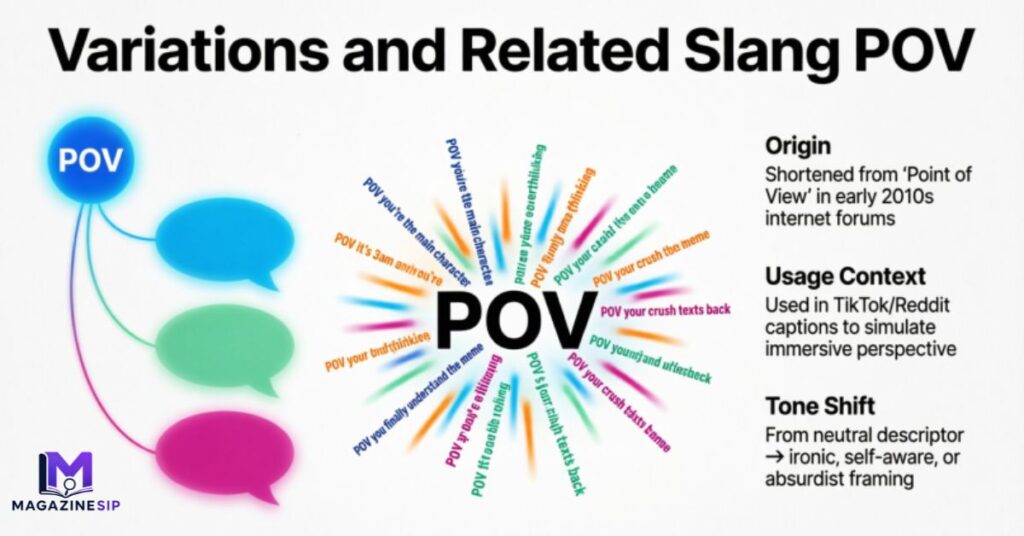
POV Meaning is closely connected to several other internet expressions, although the expressions are not interchangeable.
NGL commonly introduces an honest admission. IMO introduces an opinion. IYKYK points to an insider reference. TFW, or “That feeling when,” focuses on an emotional experience. “Me when” usually highlights the speaker’s reaction to a particular situation.
“This gives” often describes a vibe or energy. “Based” can express approval of an unapologetic opinion or behavior. SMH communicates disappointment, disbelief, or annoyance.
POV and TFW can overlap because both can introduce a feeling. POV and IYKYK can also appear together when a scenario depends on shared knowledge.
“Me when” is usually more reaction-centered. “POV: The alarm rings” places the reader into a situation, while “Me when the alarm rings” typically emphasizes the speaker’s reaction.
| Term | General function | Relationship to POV |
| POV | Point of view or scenario framing | Main expression |
| TFW | That feeling when | Similar emotional setup |
| Me when | Personal reaction | Similar but more speaker-focused |
| IYKYK | Insider reference | Different function |
| This gives | Vibe or energy | Observation rather than viewpoint |
| NGL | Honest admission | Conversation marker |
| IMO | Opinion marker | Frames a viewpoint |
| Based | Approval or unapologetic stance | Often paired with commentary |
| SMH | Reaction of disbelief | Expresses a reaction |
The difference between POV and me when is especially useful. POV asks the audience to imagine a situation, while Me when often shows how the speaker responds to it.
Is “POV” Safe for Kids?
POV Meaning itself is generally harmless. The abbreviation simply represents point of view, and children may encounter it in school, creative writing, literature, videos, games, and social media.
The safety issue is the surrounding content rather than the vocabulary. Some POV videos may involve mature topics, relationship drama, mental health, adult humor, violence, or inappropriate content.
Parents should therefore focus on content monitoring rather than treating the abbreviation itself as dangerous. A child can safely learn POV in English class and later encounter the same expression in TikTok culture.
A parent guide can explain that the term has both an academic definition and a modern slang definition. Children can learn the traditional point of view concept while also recognizing its online usage.
For younger kids, parents should discuss child safety, privacy, comments, strangers, and inappropriate content. The word itself is not the problem.
Teachers may use POV when discussing narrative perspective, narrator choices, first-person narration, and creative writing. Kids can therefore encounter the term in a completely educational context.
POV Meaning for kids is best understood as ordinary vocabulary whose safety depends on how and where it is used.
When to Use (and Avoid) “POV”
USE IT WHEN:
- Creating relatable content that invites people into a scenario
- Making TikToks, Reels, or social media posts
- Writing captions for short videos
- Texting friends about hypothetical situations
- Creating memes
- Building a playful scenario setup
- Introducing character acting
- Framing a relatable moment
- Starting a joke
- Describing an imagined experience
- Creating emotional content
- Writing a scenario-based post
- Making gaming jokes
- Describing first-person gameplay
- Introducing a visual setup
AVOID IT WHEN:
- Writing formal business emails
- Writing professional documents
- The audience may not understand internet slang
- A precise filmmaking technique is being discussed
- The phrase creates unnecessary confusion
- The situation has no useful perspective framing
- A plain sentence would be clearer
- The content requires formal written language
- You are using it repeatedly without purpose
- The intended audience expects professional communication
In casual conversation, POV can be friendly, playful, sarcastic, humorous, or observational. In professional communication, a complete explanation is often clearer.
POV Meaning is most effective when it adds framing rather than simply decorating a sentence.
Conclusion
POV Meaning ultimately comes from “point of view,” but modern slang has expanded the expression into a flexible scenario-setting tool. On TikTok, Instagram, Discord, Snapchat, Twitter/X, and other platforms, POV can invite people to imagine a situation, recognize a relatable moment, or experience a creator’s framing.
The traditional definition remains important in filmmaking, literature, storytelling, and first-person narration. Modern internet culture simply gives the abbreviation another layer, showing how language evolution can turn a technical phrase into everyday shorthand.
FAQ’s
What is a pov in social media?
POV Meaning in social media is usually a prompt that introduces a situation for the audience to imagine. The writer or creator establishes the scenario, and the audience interprets the content from that suggested viewpoint.
A social media POV does not always require a literal POV shot. A creator may show their own face, perform character acting, or use a meme while asking viewers to imagine themselves in the situation.
What is pov in gen z?
POV Meaning in Gen Z communication is commonly associated with internet slang, short videos, memes, captions, and casual online communication. It often means “imagine this situation” rather than strictly referring to a camera position.
Gen Z communication frequently uses shorthand because a short phrase can establish context quickly. POV fits that language function particularly well.
What is pov in a text?
POV Meaning in a text message is usually a quick way to introduce a hypothetical situation, joke, reaction, or relatable experience. For example, someone might text, “POV: You open your laptop and realize the assignment is due tonight.”
It is especially natural in informal conversations, group chat messages, online chat, and texting with friends. It is less suitable for formal correspondence.
How to use pov on Instagram?
POV Meaning on Instagram works well in captions, Instagram Reels, Instagram Stories, and short videos. Put “POV:” before a concise situation that the audience can easily imagine or recognize.
For example, “POV: You finally take the vacation you kept postponing” gives a Reel an immediate scenario. The visual content can then reinforce the situation through acting, scenery, photos, or video.
What’s pov in chat?
POV Meaning in chat is shorthand for setting up a situation or perspective. It can introduce a joke, meme, reaction, emotional moment, or imaginary experience.
Someone might write, “POV: Your friend says they are five minutes away but has not left home.” The recipient understands the scenario immediately, making the abbreviation useful for casual online communication.
