

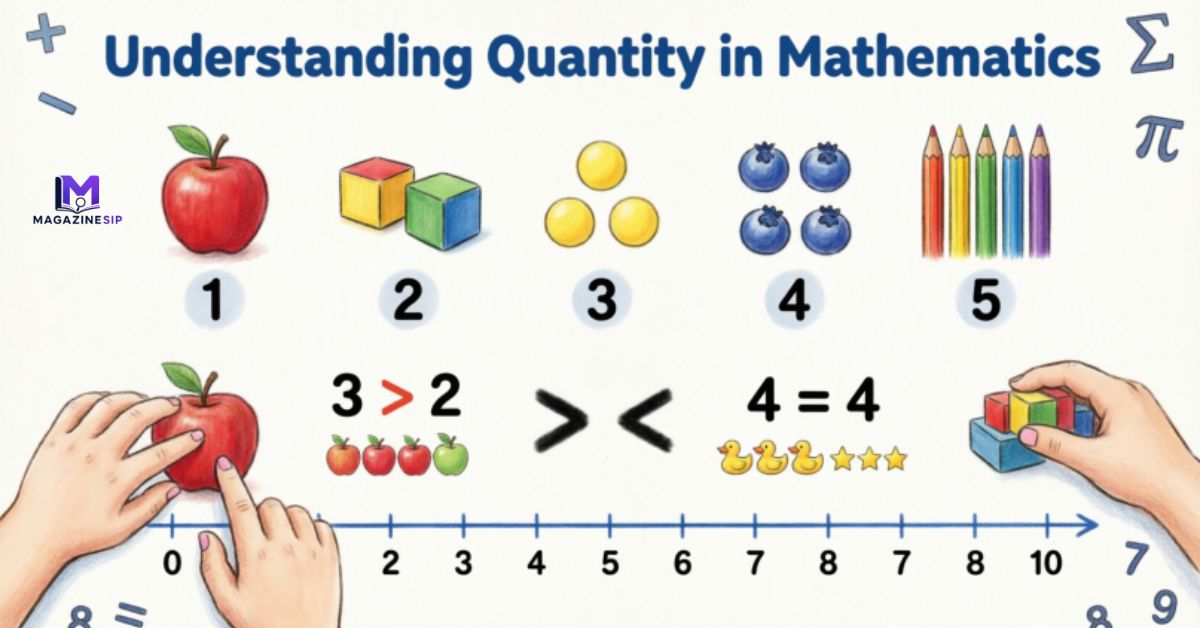
Quantity is a basic idea in mathematics that tells us how much of something there is or how many objects are present. It can describe countable things, measurable amounts, or numerical values used in calculations. When students learn quantities math, they begin to connect numbers with real objects, measurements, and mathematical relationships.
In simple terms, quantity in math answers questions such as “How many?” or “How much?” For example, 12 apples describes a countable quantity, while 2.5 liters describes a measurable quantity. Understanding this difference helps students develop number sense, comparison skills, and mathematical reasoning
The quantity meaning in math can become clearer when learners work with familiar examples from shopping, cooking, measuring, counting, and data. Whether a quantity is represented by a whole number, fraction, decimal, graph, or equation, it gives numerical information about something. This makes quantity an essential concept across arithmetic, algebra, geometry, measurement, statistics, and everyday problem-solving.
Discrete Quantity
A discrete quantity represents separate, countable objects or values. These quantities usually use whole numbers because the individual items can be counted one at a time. For example, a classroom may contain 24 students, a shelf may hold 18 books, or a basket may contain 7 oranges.
Discrete quantities answer the question “How many?” You generally cannot have 7.4 students or 12.5 chairs in a classroom. This makes whole-number counting an important part of understanding discrete quantity.
Students develop this concept through activities involving counting, one-to-one correspondence, comparing groups, and recognizing number relationships. These early experiences create a foundation for place value and arithmetic operations.
Continuous Quantity
A continuous quantity describes something that can be measured and can take many possible values, including fractions and decimals. Examples include length, temperature, time, weight, volume, and distance.
For instance, a bottle might contain 1.5 liters of water, a table could be 2.25 meters long, or a package might weigh 4.75 kilograms. These values don’t have to be whole numbers because measurement can be increasingly precise.
The difference between discrete and continuous quantities is important in measurement and data. It helps students understand why counting objects and measuring physical attributes often require different mathematical approaches.
Read More: Open Number Lines in Mathematics
Why Is Quantity Important?
Quantity gives numbers meaning. Instead of viewing a number as an isolated symbol, students learn to understand what that number represents and how it relates to other values. This is one reason the question “what does quantity mean in math?” is important for developing strong mathematical thinking.
Quantity supports counting, comparison, calculation, measurement, estimation, and data interpretation. When students understand quantities, they can recognize whether a number represents a total, a difference, a measurement, a rate, or another mathematical relationship.
For example, the number 50 could represent 50 books, 50 dollars, 50 centimeters, or 50 students. The number itself stays the same, but its meaning changes according to the context. This ability to connect numerical values with real situations is an essential part of number sense.
Quantity in Counting and Comparing
Counting is one of the earliest ways children explore quantity. When a child counts five blocks, the final number tells them the total amount in the group. This develops the idea that numbers represent quantities, not simply a sequence of spoken words.
Comparison builds on this understanding. Students learn to decide whether one group has more, fewer, or the same number of objects. Later, they use mathematical symbols such as >, <, and = to express these relationships.
One-to-one correspondence is also important. A learner who touches one object while saying one number for each item is building an accurate connection between counting and quantity. These skills eventually support place value, estimation, operations, and algebraic reasoning.
Quantity in Addition and Subtraction
Addition and subtraction help students understand how quantities change. Addition combines quantities, while subtraction can remove part of a quantity or show the difference between two amounts.
Suppose a child has 8 pencils and receives 5 more. The equation 8 + 5 = 13 shows that two quantities were combined to produce a new total. In another situation, a student may have 13 pencils and give away 5. Subtraction shows that 8 remain.
Subtraction can also represent comparison. If one basket contains 15 apples and another contains 10, the difference is 5. This shows that operations are not just procedures; they describe relationships between quantities.
Quantity in Multiplication and Division
Multiplication and division provide more advanced ways to work with quantities. Multiplication represents equal groups, repeated addition, or scaling, while division can describe equal sharing or grouping.
For example, 4 × 6 means four groups of six, giving a total quantity of 24. Similarly, 24 ÷ 6 asks how many groups of six can be made from 24. These ideas help students understand that multiplication and division are connected operations.
So, when asking “Is quantity multiplication or division?”, the answer is that quantity itself is neither operation. Quantity describes an amount, while multiplication and division are mathematical operations used to work with amounts.
Quantity in Measurement
Measurement connects quantity to physical attributes such as length, mass, capacity, area, time, and temperature. Instead of simply counting objects, students determine how much of an attribute something has.
For example, a pencil may be 15 centimeters long, a bottle may hold 750 milliliters, or a lesson may last 45 minutes. The number becomes meaningful because it is paired with a unit of measurement.
Measurement also teaches students about precision. A distance can be measured in meters, centimeters, or millimeters depending on how exact the measurement needs to be.
Quantity in Data Representation
Quantities are also central to data representation. Tables, charts, line plots, bar graphs, and picture graphs allow students to organize numerical information and compare different quantities.
For example, a bar graph might show that one student read 8 books while another read 12. Looking at the graph makes the difference easy to identify. Students can then use the information to answer questions, make comparisons, and draw conclusions.
This connection between quantities and data strengthens mathematical reasoning, interpretation, and problem-solving skills.
Teaching Strategies for Quantity

Teaching quantity works best when students can connect numbers with objects, pictures, measurements, and everyday experiences. Instead of asking learners to memorize definitions alone, teachers can provide opportunities to count, compare, estimate, measure, represent, and explain quantities.
Hands-on activities can include counters, blocks, measuring tools, number cards, graphs, and classroom objects. Visual models are particularly useful because they make abstract numerical ideas easier to understand.
Teachers can also ask open-ended questions such as, “How do you know this group has more?” or “Can you show the same quantity another way?” Such questions encourage students to explain their thinking rather than simply provide an answer.
Quantity in Real-World Contexts
Real-world situations make the quantity meaning in math easier to understand. Students encounter quantities throughout the day, whether they are counting money, measuring ingredients, checking time, comparing prices, or determining distances.
For example, a grocery activity can ask students to compare the quantities of two products. A cooking activity can introduce fractions and measurements, while a classroom survey can help students collect and represent numerical data.
These experiences show that quantities are not limited to textbooks. They are part of shopping, travel, cooking, sports, science, finance, and daily decision-making.
Quantity As Visual Representations
Visual representations help learners see quantities instead of relying only on numerical symbols. A picture, model, chart, or graph can show how amounts relate to each other.Tally charts are useful for recording discrete quantities. Students can use one tally mark for each item and then group marks to make counting easier.
Bar graphs and picture graphs can represent quantities in a simple visual format. Learners can quickly identify which category has the greatest or smallest amount.Number lines provide another useful representation. They show the relative position of numbers and can help students visualize addition, subtraction, comparison, distance, and changes in quantity.
Explore Relationships Between Quantities
Students gain stronger number sense when they explore how one quantity relates to another. Instead of treating numbers as separate values, they learn to recognize patterns, equivalence, differences, and proportional relationships.
For example, learners can split 20 counters into four equal groups to explore division. They can combine 7 and 8 objects to understand addition or compare 15 objects with 11 objects to find the difference.
These activities also prepare students for more advanced ideas such as fractions, ratios, proportions, algebraic expressions, and functions. Understanding relationships between quantities is therefore an important step toward higher-level mathematics.
Quantity in math symbol
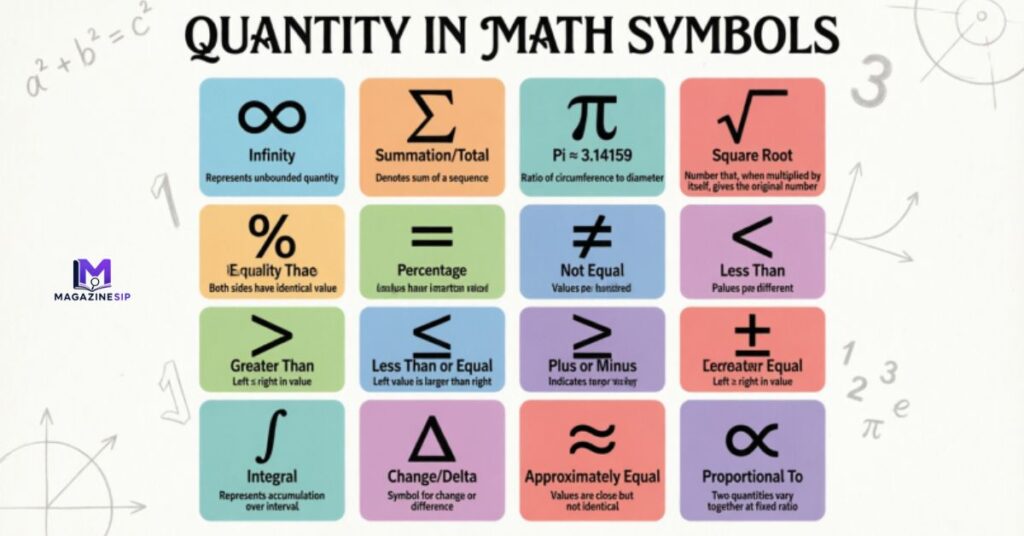
There is no single universal symbol that always means quantity in math. The symbol used depends on what quantity is being represented. A variable such as x, n, or q may represent an unknown or changing quantity.
Numbers themselves also represent quantities. For example, in the expression 6 + 4 = 10, the numbers 6 and 4 represent quantities being combined, while 10 represents the resulting quantity.
Units can provide additional meaning. In 5 kg, the number 5 tells the amount and kg identifies the measurement unit.
Quantity in mathematics formula
A quantity can appear inside many different mathematical formulas. The appropriate formula depends on the type of quantity and the relationship being studied.
For example, the formula for distance can be written as distance = speed × time. Here, distance, speed, and time are measurable quantities connected through a mathematical relationship.
Similarly, the area of a rectangle can be found using A = length × width. Both length and width describe measurable quantities, while area represents another quantity produced by the relationship between them.
Types of quantity in mathematics
The types of quantity in mathematics can be understood in several ways depending on context. A common distinction is between discrete quantities and continuous quantities.
Discrete quantities are countable, such as the number of students in a class. Continuous quantities are measurable, such as height, mass, or temperature.
Quantities may also be described as scalar or vector quantities in more advanced mathematics and science. A scalar has magnitude only, while a vector has both magnitude and direction. This broader classification shows how the idea of quantity develops as mathematical learning becomes more sophisticated.
Quantity in mathematics examples
Quantity in mathematics examples can be found in almost every branch of math. If a box contains 12 pencils, then 12 represents a discrete quantity. If the box weighs 2.4 kilograms, then 2.4 kg represents a measurable quantity.
Other examples include 45 minutes of time, 3.5 liters of water, 20 students, 75 dollars, or 6 meters of rope. Each value describes an amount in a specific context.
These examples help students understand that quantity is about the amount represented by a number, while the surrounding context tells us what that amount refers to.
Quantity in math expression
A quantity can be represented directly or indirectly within a math expression. For example, 7 + 3 represents two quantities being combined, while 5x represents a quantity that is five times another quantity.
Variables are particularly useful when the exact quantity is unknown or can change. In the expression x + 4, x can stand for different values, while 4 remains a fixed quantity.
Understanding quantities in expressions helps students move from basic arithmetic toward algebraic thinking, where relationships between known and unknown values become increasingly important.
Is quantity multiplication
Quantity is not multiplication. Quantity refers to an amount, while multiplication is an operation used to combine equal groups or scale an amount.
For example, if there are 5 groups with 4 objects in each group, multiplication gives 5 × 4 = 20. Here, 20 is the resulting quantity, and multiplication is the operation used to find it.
Is quantity multiplication or division
Quantity can be involved in both multiplication and division. Multiplication can increase or scale a quantity, while division can split or group a quantity.
For example, multiplying 6 by 3 gives a quantity of 18. Dividing 18 by 3 gives a quantity of 6. The operation changes, but the concept of quantity remains central to both calculations.
Quantity examples in business

Businesses use quantities to describe inventory, sales, prices, production, customers, time, and resources. For example, a store may have 250 products in stock, sell 40 items in one day, and receive 100 new items in a shipment.
Quantity also supports financial planning. A business might calculate how many units it needs to sell to reach a sales target or compare the quantity of products sold during different months.
These practical applications show why understanding what does quantity mean is useful far beyond classroom mathematics. Quantity provides a way to measure, compare, and make decisions using numerical information.
FAQs
What is a quantity in math?
A quantity in math is an amount that can be counted, measured, or represented using numbers. For example, 8 apples and 2.5 liters both describe quantities.
How to identify quantity?
Look for the amount being counted or measured in a situation. Ask “How many?” for countable items or “How much?” for measurable amounts.
What is quantity and example?
Quantity means the amount of something. For example, if a box contains 15 pencils, 15 pencils is the quantity.
What is the definition of quantity?
Quantity is a numerical amount that describes how many items there are or how much of something exists. It can be discrete or continuous.
What is the definition of “quantity” in a simple way?
In simple words, quantity means an amount. It tells you how many things there are or how much of something you have.
Conclusion
Quantity is one of the most important ideas in mathematics because it gives meaning to numbers. From counting objects to measuring distance, comparing values, analyzing data, and solving equations, quantities appear throughout mathematical learning. Understanding what does quantity mean in math helps students see numbers as representations of real amounts rather than isolated symbols.
The difference between discrete and continuous quantities also gives learners a stronger foundation for counting and measurement. As students progress, they use quantities in addition, subtraction, multiplication, division, algebra, geometry, statistics, and real-world decision-making. Visual models, hands-on activities, graphs, and everyday examples can make these ideas easier to understand. Whether you’re exploring quantities math, a mathematical expression, or a measurement formula, the central idea remains the same: quantity describes an amount and shows how that amount relates to other values. Building this understanding early can make more advanced mathematical concepts much easier to grasp.
Meta Description:
Learn what quantity means in math, its types, symbols, formulas, examples, and real-world uses with simple explanations for students and learners.
