

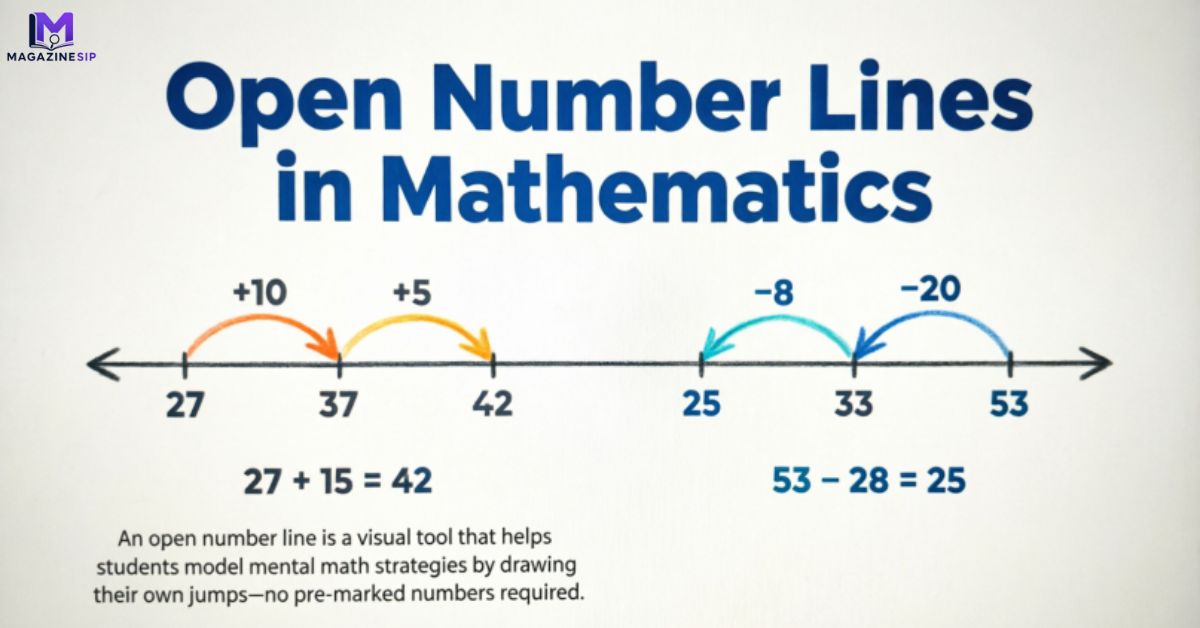
An open number line is a flexible visual strategy that helps students make sense of numbers and solve arithmetic problems. Unlike a traditional number line with fixed labels and equal marks, an open number line begins mostly blank, so learners decide where to place numbers, how far to jump, and which steps make the calculation easier. This flexibility supports addition, subtraction, multiplication, and division while encouraging students to explain their mathematical thinking.
For example, a learner solving 48 + 27 might begin at 48, jump 20 to 68, and then move 7 more to reach 75. The same model can show subtraction by moving backward or finding the distance between two values. Because students can break numbers into friendly chunks, open number lines strengthen place value, mental math, estimation, and number sense. In this guide, you’ll learn how open number lines work, why they matter, and how to use them confidently.
Understanding Open Number Lines in Mathematics
An open number line is a blank or flexible representation of numbers that students can build as they solve a problem. Unlike a closed number line, which normally has predetermined points, labels, or intervals, an open model lets the learner decide which numbers are useful and where to place them.
A traditional number line might already show 0, 1, 2, 3, 4, and so on. With an open number line, a student may draw a simple horizontal line, place 37 somewhere on it, and then create jumps that represent the numbers being added or subtracted. The model does not require every number to be written down.
This flexibility is one of the main strengths of open number lines. Students can use large jumps for hundreds or tens and smaller jumps for ones. They can also use friendly numbers to make mental calculations easier. For example, to solve 48 + 27, a student could start at 48, jump 20 to 68, and then jump 7 to reach 75.
For subtraction, students can move backward or think about the distance between two numbers. To solve 63 − 28, a learner might jump back 20 to reach 43 and then back 8 to reach 35. Another learner could start at 28 and count forward to 63. Both strategies show the same mathematical relationship.
Open number lines are therefore more than drawing tools. They help students represent place value, number relationships, mental math, decomposition, compensation, and computation strategies visually. Educational mathematics resources describe them as blank number lines that allow students to choose useful points and record their mental-computation strategies.
Why Are Open Number Lines Important?
Open number lines are important because they allow students to show how they think, not just what answer they get. In early mathematics, children often learn to count forward, count backward, and solve simple addition and subtraction problems. A flexible number line gives them a visual place to record those movements.
For example, when solving 25 + 16, a student might begin at 25, jump 10 to 35, and then jump 6 to reach 41. Another student may jump 5 to reach 30, then 10 to reach 40, and finally 1 to reach 41. Both approaches are correct, but the second strategy demonstrates how a learner can use a friendly number to make computation easier.
The same idea becomes useful with larger numbers. Students can break apart an addend according to hundreds, tens, and ones, which reinforces place-value understanding. They may also use compensation, such as adding 30 and then taking away 1 when adding 29.
Open number lines also help learners understand subtraction as more than simply “taking away.” When students place two numbers on a line and find the distance between them, subtraction becomes a comparison of quantities.
As mathematical ideas become more advanced, the same visual strategy can represent fractions, decimals, negative numbers, multiplication, and division. A standard number line can also represent these values, but the open version gives learners greater freedom to choose useful intervals and starting points.
Read More: Understanding Not Equal In Mathematics
Using Open Number Lines for Computation
Open number lines are particularly useful when students need to develop flexible computation strategies. Rather than following one rigid sequence of steps, learners can choose jumps that match the numbers in the problem.
For example, if the problem is 236 + 148, a student could begin at 236 and break 148 into 100, 40, and 8. The jumps would lead to 336, 376, and finally 384. Another student might add 4 first to reach 240, then add 100, 40, and 4. This second method uses a convenient multiple of ten as an intermediate point.
This type of reasoning strengthens number sense because students learn to recognize useful relationships between numbers. Open number lines can also make mental computation visible, giving teachers an opportunity to discuss why different methods work.
Using an Open Number Line to Add
Using an open number line addition strategy begins by selecting a starting number, usually one of the addends. The other addend is then broken into manageable jumps.
Consider:
125 + 347
One approach is to start at 125 and add 300, 40, and 7:
125 → 425 → 465 → 472
Therefore:
125 + 347 = 472
A learner could also use a more efficient strategy by first reaching a friendly number. Starting at 125, the student might add 5 to reach 130. Then they can add 300, 40, and 2:
125 → 130 → 430 → 470 → 472
The total movement is still 347, but the second strategy may feel easier because 130 is a convenient number to work with.
This is why open number line addition is valuable. Students do not have to divide numbers into exactly the same chunks every time. They can use place value, compensation, and friendly numbers according to their own reasoning.
For a problem such as 58 + 26, a student might add 20 first and then 6:
58 → 78 → 84
Another student might add 2 to reach 60, then add 24:
58 → 60 → 84
Both produce the same answer.
The goal is not to make every student use one identical drawing. Instead, the open number line encourages students to find an efficient and mathematically sound route to the answer.
Using an Open Number Line to Subtract
An open number line subtraction strategy can represent subtraction as either taking away or finding the difference between two values.
Suppose the problem is:
462 − 284
One student might start at 462 and move backward. They could subtract 200, then 80, then 4:
462 → 262 → 182 → 178
So:
462 − 284 = 178
However, counting backward is not always the easiest method. Another student may start at 284 and count forward until reaching 462. For example:
284 → 300 = +16
300 → 400 = +100
400 → 462 = +62
Then add the jumps:
16 + 100 + 62 = 178
This approach treats subtraction as finding the distance between two numbers.
The advantage becomes even clearer with a problem such as 503 − 297. Instead of subtracting 297 directly, a student might recognize that 297 is close to 300:
297 → 300 = 3
300 → 500 = 200
500 → 503 = 3
The total distance is:
3 + 200 + 3 = 206
Therefore:
503 − 297 = 206
This strategy demonstrates compensation and number flexibility. Students learn that subtraction does not always require moving backward one small step at a time.
Using an Open Number Line to Multiply

An open number line can represent multiplication as equal jumps or repeated addition. The size of each jump represents one group, while the number of jumps represents how many groups are being combined.
For example, to solve:
6 × 4
A student can start at 0 and make six jumps of 4:
0 → 4 → 8 → 12 → 16 → 20 → 24
After six equal jumps, the learner reaches 24.
Therefore:
6 × 4 = 24
The same model could represent 4 × 6 with four jumps of 6:
0 → 6 → 12 → 18 → 24
This gives students a visual way to understand why multiplication represents equal groups.
Open number lines in mathematics multiplication can also support larger facts. For 7 × 8, students can make seven jumps of 8 or use larger chunks, such as repeated groups of 16. This flexibility connects multiplication with skip counting, repeated addition, and efficient calculation.
Using an Open Number Line to Divide
An open number line can make division easier to visualize because students can represent division through equal groups or repeated subtraction.
Consider:
20 ÷ 4
Start at 20 and make equal jumps backward by 4:
20 → 16 → 12 → 8 → 4 → 0
There are five jumps, so:
20 ÷ 4 = 5
Students can also start at 0 and count forward in groups of 4 until they reach 20:
0 → 4 → 8 → 12 → 16 → 20
Again, there are five groups.
This model helps students connect division with multiplication. If five jumps of 4 reach 20, then 5 × 4 = 20, so 20 ÷ 4 = 5.
Open number lines are especially useful when introducing division because they allow learners to see the quotient as the number of equal jumps rather than simply memorizing a division fact. Number-line division resources similarly use equal jumps and repeated subtraction to make the relationship between divisor, dividend, and quotient more visible.
Developing Mental Representations
As students become comfortable drawing open number lines, they can gradually begin using the same strategies mentally. At first, a learner may need to draw every jump. With practice, the number line can become an internal image.
For example, consider:
45 + 32
A student might visualize:
45 → 75 → 77
They know that adding 30 gives 75 and adding 2 gives 77.
The same idea works with subtraction. For 82 − 37, a student might think:
82 − 30 = 52
52 − 7 = 45
There may be no physical number line on the page, but the learner is still using the same mental structure.
This progression from concrete representation to visual representation and then mental computation is valuable because students gradually become more independent. They learn to choose efficient jumps without depending on a worksheet or drawing every step.
Mental representations also improve estimation. Before calculating 398 + 204, a student can recognize that the answer should be close to 600. If the final result is 602, it makes sense. If the result is 6,020, the estimate signals that something went wrong.
Encouraging Mathematical Communication with Open Number Lines
Open number lines naturally encourage students to explain their strategies. Since different learners can solve the same problem using different jumps, the classroom becomes a place for comparing mathematical reasoning rather than simply checking answers.
Teachers can ask questions such as:
- “Why did you choose that number as your starting point?”
- “Why did you break the number into those particular jumps?”
- “What made you decide to count forward or backward?”
- “Could you solve the problem using fewer jumps?”
- “How is your strategy similar to your classmate’s?”
- “Could you find another route to the same answer?”
- “Which jump made the calculation easier?”
These questions help students use mathematical vocabulary such as addend, difference, sum, product, quotient, place value, equal groups, and difference between numbers.
Communication is important because a correct answer does not always reveal whether a student understands the underlying concept. When learners explain why they chose a particular jump, teachers can identify misconceptions and build on effective strategies.
Open number lines therefore support both computation and mathematical communication. They encourage students to treat their strategies as something worth explaining, comparing, and improving.
Open number lines in mathematics worksheets
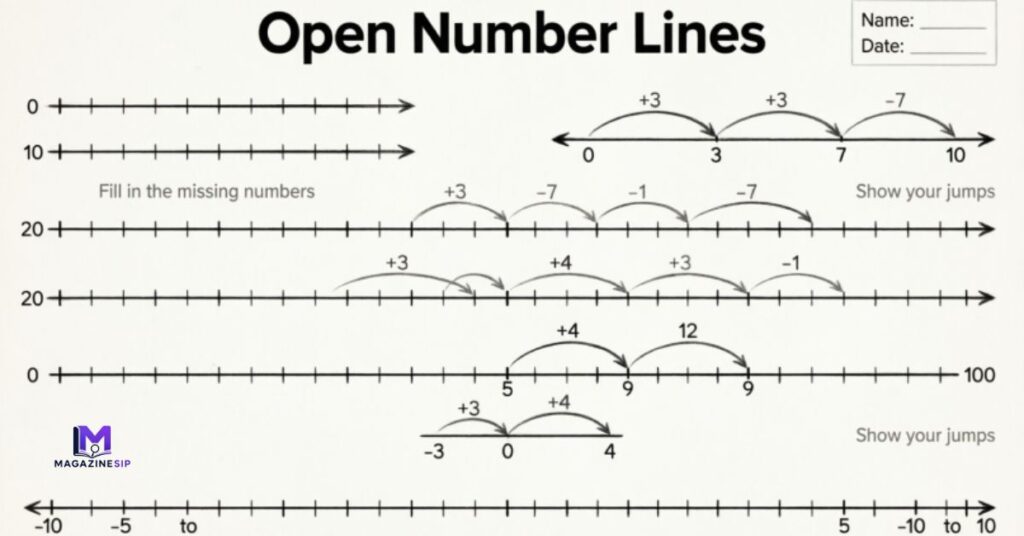
Open number lines in mathematics worksheets provide structured practice while still giving students freedom to choose their own strategies. Instead of showing every number on the line, a worksheet may provide a blank line and an arithmetic problem, asking students to record their starting point and jumps.
For example, a worksheet might include:
47 + 35 = ?
A student could show:
47 → 77 → 82
Another student could show:
47 → 50 → 80 → 82
Both drawings demonstrate valid addition strategies.
A good worksheet can gradually increase difficulty. Beginners may work with numbers under 20, while more advanced learners can solve two- or three-digit problems. Worksheets can also include addition, subtraction, multiplication, division, fractions, decimals, and missing-number problems. Number-line worksheets commonly cover operations as well as whole numbers, integers, fractions, and decimals.
Open number line subtraction
Open number line subtraction is particularly useful for helping students understand subtraction as a difference or distance. Instead of automatically counting backward, learners can place the smaller and larger numbers on the line and calculate how far apart they are.
For example, solve:
74 − 38
Start at 38 and count forward:
38 → 40 = 2
40 → 70 = 30
70 → 74 = 4
Now add the jumps:
2 + 30 + 4 = 36
Therefore:
74 − 38 = 36
This method uses friendly numbers and makes the calculation easier to track. It also shows why subtraction can be connected to addition: if 38 + 36 = 74, then 74 − 38 = 36.
Open number line worksheet
An open number line worksheet can focus on one skill at a time or combine several operations. For early learners, a worksheet might provide simple addition problems and ask students to draw jumps. Later exercises can introduce larger numbers and encourage students to use efficient strategies.
For example:
Solve 156 + 28 using an open number line.
One possible solution is:
156 → 176 → 184
Another is:
156 → 160 → 180 → 184
The second approach demonstrates compensation and place-value thinking.
Teachers can also use blank printable templates for students to create their own models. This gives learners more control over the representation and can make it easier to discuss different strategies in class.
Open number lines in mathematics examples
There are many open number lines in mathematics examples that show how flexible the strategy can be.
For addition:
64 + 29
A student could jump:
64 → 84 → 93
So the answer is 93.
For subtraction:
91 − 46
A learner could count forward:
46 → 50 = 4
50 → 90 = 40
90 → 91 = 1
Total:
4 + 40 + 1 = 45
For multiplication:
5 × 7
Make five jumps of 7:
0 → 7 → 14 → 21 → 28 → 35
Therefore, the product is 35.
For division:
30 ÷ 5
Make equal jumps of 5 until reaching 30:
0 → 5 → 10 → 15 → 20 → 25 → 30
There are six jumps, so the quotient is 6.
These examples demonstrate how one flexible model can support several arithmetic operations.
Open number lines in mathematics multiplication
Open number lines in mathematics multiplication can help students understand multiplication as repeated equal groups. Instead of viewing 4 × 9 only as a memorized fact, a learner can represent it with four equal jumps of 9.
0 → 9 → 18 → 27 → 36
The final point is 36.
Students can also use larger jumps to solve multiplication more efficiently. For example, 6 × 12 can be represented as six jumps of 12, but a learner could think of three jumps of 24 instead.This encourages students to recognize relationships between multiplication facts and use skip counting, equal groups, repeated addition, and decomposition.
Open number line addition
Open number line addition gives learners a flexible way to break an addend into parts. The strategy is especially helpful with two- and three-digit numbers because students can separate hundreds, tens, and ones.
For example:
274 + 126
Start at 274:
274 → 374 by adding 100
374 → 394 by adding 20
394 → 400 by adding 6
Therefore:
274 + 126 = 400
This approach makes the place-value structure visible and gives students an alternative to relying only on the standard written algorithm.
Open number line subtraction 2nd Grade
Open number line subtraction 2nd Grade activities can introduce subtraction through simple jumps and friendly numbers.
For example:
52 − 19
A child might begin at 52, jump back 10 to 42, and then jump back 9 to reach 33.
Another strategy is to think of the distance from 19 to 52:
19 → 20 = 1
20 → 50 = 30
50 → 52 = 2
So:
1 + 30 + 2 = 33
This second method helps students see subtraction as finding the difference and can be easier than counting backward one number at a time.
Open number lines printable

Open number lines printable resources can be useful for classroom practice, homework, tutoring, or independent learning. A simple printable template can contain a blank horizontal line where students place their own starting numbers, intermediate values, and jump labels.
For younger students, the teacher might provide problems such as 16 + 8 or 25 − 7. For older students, printable activities can include larger numbers, multiplication, division, fractions, and decimals.The main advantage of a blank template is that students must decide what information is useful rather than simply following preprinted intervals. This supports strategic thinking and number sense.
Frequently Asked Questions
What are the 7 types of lines in mathematics?
Common geometric lines include horizontal, vertical, diagonal, curved, parallel, perpendicular, and intersecting lines. The exact classification can vary depending on the mathematics topic being taught.
What does open and closed mean on a number line?
An open point or circle usually means the endpoint is not included in a graph or inequality. A closed point or circle means the endpoint is included.
What are number lines in math?
A number line is a visual representation of numbers arranged in order along a line. It helps students compare values and understand addition, subtraction, distance, fractions, and other number relationships.
How to do open number line subtraction?
Start with the numbers involved and decide whether counting backward or finding the distance is easier. Break the subtraction into useful jumps, record each jump, and combine them to find the difference.
What is an open number line?
An open number line is a mostly blank number line that students customize while solving a problem. They choose useful starting points, labels, and jumps instead of relying on fixed markings.
Conclusion
Open number lines give students a practical way to see the thinking behind arithmetic instead of relying only on memorized procedures. Because the line is flexible, learners can choose useful starting points, break numbers into manageable parts, and record jumps that match their own strategies. This makes the model valuable for addition, subtraction, multiplication, and division, while also supporting place value, mental computation, estimation, and mathematical communication.
An open number line can begin with a simple problem such as 23 + 14 and support more complex calculations involving larger numbers, fractions, or decimals. Comparing an open number line with a closed number line also helps students understand why flexible representations can be useful. With practice through classroom activities, worksheets, and real-world problems, students can gradually move from drawing every jump to visualizing the strategy mentally. The goal is not simply to reach an answer, but to understand why the strategy works.
